

























































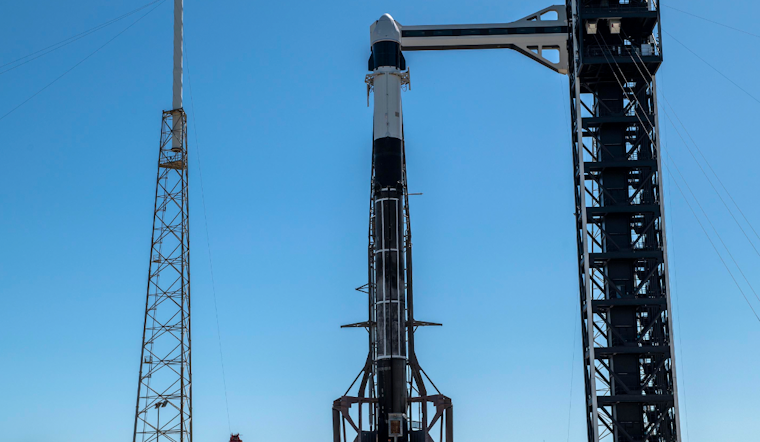
SpaceX is lining up another loud night on the Space Coast, targeting a Tuesday evening launch of the CRS‑34 resupply mission from Cape Canaveral’s Space Launch Complex 40 at 7:16 p.m. ET, with a backup opportunity on Wednesday at 6:50 p.m. ET. If the Falcon 9’s first stage goes for a return‑to‑launch‑site landing at Landing Zone 40, parts of Central Florida could be in for one or more sonic booms. The uncrewed Dragon capsule is hauling about 6,500 pounds of supplies and experiments to the International Space Station and is expected to dock roughly 38 hours after liftoff.
The Falcon 9’s first stage is slated to try for that landing at Landing Zone 40 right next to the pad, a move that has triggered audible booms on previous missions, and both the booster and the Dragon flying this time are making their sixth trips to orbit, according to Space Coast Daily. A live webcast is scheduled to start about 20 minutes before liftoff for those who would rather catch the action from the couch than from the causeway.
When and Where to Listen
The 45th Weather Squadron at Space Launch Delta 45 has pegged the odds of acceptable launch weather at just 35% for the primary Tuesday window and 65% for Wednesday, with local coverage noting that the outlook climbs to around 85% if the attempt slips to Thursday, per the Orlando Sentinel. Forecasters are keeping a close eye on cumulus clouds, anvil clouds and surface electric fields, any one of which can force teams to wave off. Whether residents actually hear a boom will come down to the exact flight corridor and what the atmosphere is doing at launch time.
What’s Aboard and When It Arrives
Dragon’s cargo load of roughly 6,500 pounds includes science experiments dubbed Odyssey, STORIE and SPARK, a wood‑derived bone scaffold known as Green Bone, and hardware to support the station’s power and water‑processing systems, according to Bay News 9. After its roughly 38‑hour cruise, Dragon is slated to dock autonomously to the station at about 9:50 a.m. ET and is expected to stay attached for around a month before returning to Earth for a Pacific splashdown with research samples and other cargo.
Why Some Neighborhoods Might Rattle
When boosters head back to the Cape at supersonic speeds, they generate shock waves that hit the ground as sonic booms. Federal environmental reviews say the overpressures from a typical Falcon 9 ascent and landing are generally low and unlikely to cause structural damage, but they can absolutely be loud enough to make people jump. The Kennedy Space Center Visitor Complex notes the mission’s planned landing at LZ‑40 and related viewing options, and officials have for years warned residents across Brevard and nearby counties that booms are part of the package, a message backed up by federal modeling of how a “boom carpet” can spread across the region, as detailed in the FAA.
On‑site viewing at the Visitor Complex and other popular spots may be limited, but the mission will be streamed on SpaceX’s webcast and partner feeds. Local outlets have also suggested tying down loose outdoor items and keeping an eye on pets, since the rumble can sometimes rattle windows and nerves. For last‑minute go or no‑go calls, residents are urged to watch updates from SpaceX and Space Launch Delta 45; teams will only press ahead if strict weather rules are met, and any delay will shift the attempt to the posted backup windows.



