

























































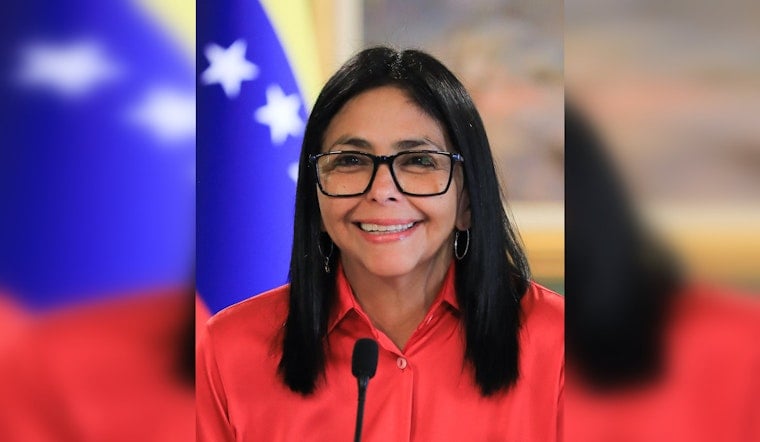
Acting President Delcy Rodríguez is touting a sharp bump to Venezuela’s “comprehensive minimum income,” saying it will climb to the equivalent of $240 a month, with pensions rising to about $70. Rolled out as a big pre–International Workers’ Day gesture at a rally in Caracas, the plan was framed as a major win for workers. What it was not, at least for now, was clear on how much is actual salary and how much is temporary bonus money. Labor groups say that missing detail is exactly the problem and that the move still falls well short of restoring purchasing power.
Announcement details and official framing
Rodríguez laid out the package on April 30 at a public event in Caracas, saying it would cover public employees and should be matched in the private sector. She did not spell out how the $240 figure breaks down between formal wages and bonuses, according to Reuters. The acting president cast the move as a first step toward rebuilding workers’ buying power, while conceding that the new pension level is still not enough for retirees to live on comfortably.
What the number actually means for paychecks
Behind the headline figure is a familiar structure: a very small, frozen base wage topped up with food coupons and so-called “economic war” bonuses. Critics argue that by leaning on bonuses - which do not count for pensions, severance or other benefits - the government keeps people dependent on discretionary payments instead of enforceable labor rights. The Association of Professors at the Central University of Venezuela called the refusal to set a clear national minimum wage “a continued violation of the Constitution,” according to the Miami Herald. Unions add that this bonus-first strategy weakens collective bargaining and undercuts the social protections that a stable base salary is supposed to guarantee.
Workers push back
Unions and labor organizations were quick to signal that the new numbers would not tamp down their plans for May 1. Workers were expected to take to the streets on International Workers’ Day to demand a real wage floor and stronger protections, as reported by the AP. Tensions were already high after an April march by workers toward the presidential palace was stopped short, with police blocking and repressing the union demonstration on April 9, an episode documented by EFE. Those scenes set the stage for a confrontational May Day backdrop to Rodríguez’s announcement.
Inflation eats the gains
The raise lands in an economy where prices are racing ahead of almost any pay adjustment. Central bank figures cited in local coverage show cumulative price growth of about 71.8% in the first quarter of 2026, according to Descifrado. On a longer horizon, Reuters reported central bank data putting annual inflation near 650% in March. That context makes the roughly 26% increase in the income package look fragile. Even if workers see the full amount in their accounts, persistent inflation can quickly chew through any apparent gain.
What it means for businesses
Rodríguez urged private employers to match the $240 figure wherever salaries are currently below that mark. She did not, however, pair that call with tax incentives, subsidies or other relief to offset higher payrolls. Business groups warned that mandatory increases without support could squeeze already fragile companies, especially small firms, and encourage more employers to shed formal staff in favor of informal, unprotected labor arrangements. Those concerns were highlighted in reporting by the Miami Herald.
Bottom line
Economists and analysts see the new package as buying the government some political breathing room rather than fixing the underlying problems. They point to three missing pieces: a meaningful and enforceable base wage, a more stable currency and a credible plan to rein in inflation. Without that trio, any bonus-heavy income floor is unlikely to restore purchasing power for long. Recent coverage by Bloomberg underscored that view, noting the increase comes amid rising social unrest. For now, Venezuelan workers and employers are left to see whether the $240 promise becomes real relief or just another short-lived adjustment in an economy where the cost of living keeps sprinting ahead.


_(cropped_2).jpg)