

























































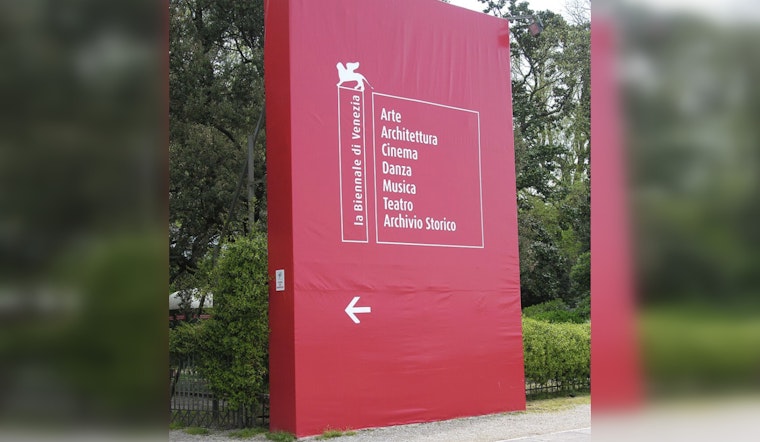
Opening weekend at the Venice Biennale is usually an insider art-world warmup. This year, it kicked off more like a political showdown. On Saturday, May 9, 2026, the exhibition opened amid loud protests and an unprecedented rupture at the top: the international jury had quit days earlier over whether artists from Israel and Russia should be eligible for prizes. Organizers scrapped the traditional Golden Lion awards for the opening stretch and handed power to the crowd instead. Now, prizes will be decided by a public vote of ticket-holding visitors, with the winners scheduled for announcement on the final day of the biennale, November 22. Outside the pavilions in the Giardini and the Arsenale, preview guests and demonstrators tangled in tense standoffs, turning an ordinarily inward art ritual into a full-contact international spectacle.
Jury Walkout Forces Award Overhaul
On April 30 the five-person international jury announced that it was stepping down "in acknowledgement" of a Statement of Intention that would have blocked prizes for artists from countries whose leaders face charges at the International Criminal Court. The move left organizers scrambling to salvage the awards structure. In response, they shifted the ceremony to the biennale's final day and created a new system of prizes, now branded the Visitors' Lions, which will be chosen by attendees who visit both the Giardini and the Arsenale, according to Biennial Foundation.
Politics Puncture Venice's 'Place of Truce'
The walkout followed a juror declaration that countries whose leaders face ICC charges should be excluded from prize consideration, a stance widely read as targeting Russia and Israel. The fallout moved quickly from curatorial debate to political headache. Italy's culture ministry dispatched inspectors, and the European Commission warned that a €2 million grant could be put on hold, as reported by The Guardian. For an event that likes to call itself a "place of truce," the timing could hardly be more combustible.
Artworks That Have Provoked Heat
Inside the Israeli pavilion, Belu-Simion Fainaru's Rose of Nothingness has become one of the flashpoints. The installation includes hanging padlocks engraved with Hebrew phrases and a water work whose pulses the artist describes as carrying mystical meaning. Outside, on the preview days, demonstrators raised the volume with disruptions at several national pavilions. Austria's Seaworld Venice, a performance-heavy installation that foregrounds water and waste, has added to the sense of spectacle and confrontation rippling through the grounds, according to The Associated Press.
How the Visitors’ Vote Will Work
La Biennale says any ticketholder who visits both the Arsenale and the Giardini will be eligible to vote for two prizes: Best Participant in the main exhibition and Best National Participation. Attendance will be verified through the ticketing system before ballots are counted. The new setup allows organizers to keep their official line on inclusion intact while passing the hard decisions to the paying public. According to Biennial Foundation, the two Visitors' Lions are set to be awarded on November 22.
Curator's Vision Lives On
This edition of the exhibition was curated in memory of the late Koyo Kouoh and gathers roughly 110 artists and groups, all selected to explore minority perspectives. Kouoh began shaping the program before her death in 2025, and co-curators have carried her blueprint through to the final show. Participants and organizers say her framework is visible throughout the exhibition, even as political tempests roll over the fairgrounds, according to The Associated Press.
Why It Matters Back Home
For U.S. museums, collectors and galleries, the turmoil in Venice is more than distant drama on the lagoon. It is a pointed reminder that cultural institutions can be pulled directly into geopolitical crossfire, and that seemingly abstract programming decisions can carry heavy reputational stakes. The argument over exclusion versus inclusion is already filtering into programming talks in New York and other cities, as critics and directors debate whether festivals should mirror the political climate or try to stand apart from it, observers told The Art Newspaper.




.jpg)