

























































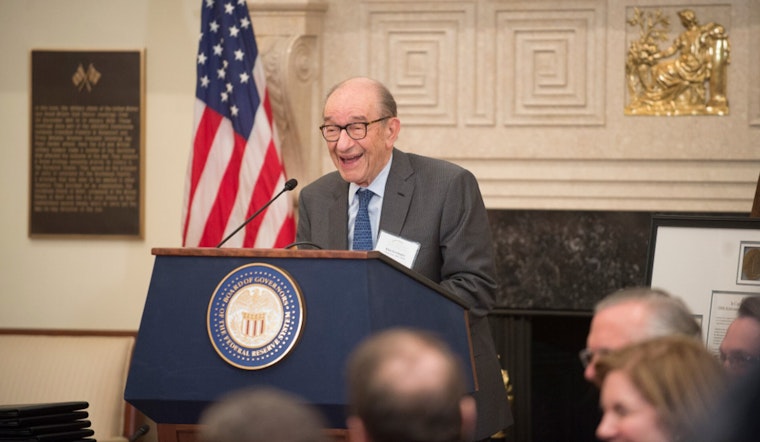
Alan Greenspan, the economist who spent nearly two decades as the most closely watched man in global finance, died Monday at 100. The former Federal Reserve chair steered the central bank through booms, crashes and the daily knife fight of Washington politics, helping shape the long 1990s expansion and the bruising regulatory debates that followed. His passing effectively closes the book on a generation of central bankers whose decisions still echo in markets and policy circles.
His wife, NBC News correspondent Andrea Mitchell, said he died Monday at his home from complications of Parkinson's disease, according to AP. In the statement cited by the outlet, Mitchell wrote, "To me he was my husband, who shaped my life from our very first date in 1984," and said he would be remembered for "his brilliance and his kindness."
Greenspan served as Fed chair from 1987 to 2006, an 18½-year run that stretched across four presidential administrations and some of the era's most dramatic market episodes. The Federal Reserve's historical archive recounts how his tenure encompassed everything from the 1987 stock market crash to the tech-cycle boom that followed, according to Federal Reserve History.
He built a reputation as a market-friendly central banker who championed deregulation and free trade, while occasionally sounding alarms about asset bubbles. His most famous warning came in a 1996 speech that introduced the now-iconic phrase "irrational exuberance." Those tensions between caution and faith in markets run through today's obituaries and retrospectives, which track both his influence and the disputes he left behind, according to The New York Times.
Record And Controversy
For years, Greenspan was feted as an "Oracle" and a "Maestro" whose carefully parsed sentences could send traders scrambling. Later, critics blamed his confidence in self-regulating markets and relatively easy monetary policy for helping inflate the housing boom that imploded in the late 2000s. Greenspan eventually acknowledged misjudging those market dynamics, telling reporters, "I made a mistake" about the limits of market self-regulation, a concession noted by AP. That admission has become a touchstone for historians and economists reassessing his legacy.
Why His Influence Still Matters
Fights over whether central banks should lean against asset bubbles, and the Wall Street shorthand of a so-called "Fed put" that assumes rescue in a crisis, trace back to norms that took shape under Greenspan. An examination of the Greenspan era walks through how those expectations formed and why they continue to inform both monetary policy and market behavior, according to Frontline.
Greenspan received the Presidential Medal of Freedom in 2005 and is survived by his wife, Andrea Mitchell, among others, biographical summaries note. As tributes and critiques rolled in, his death quickly sparked fresh reflection on both the growth he helped guide and the regulatory gaps his critics say were left in his wake, per biographical coverage by Britannica.




.jpg)