

























































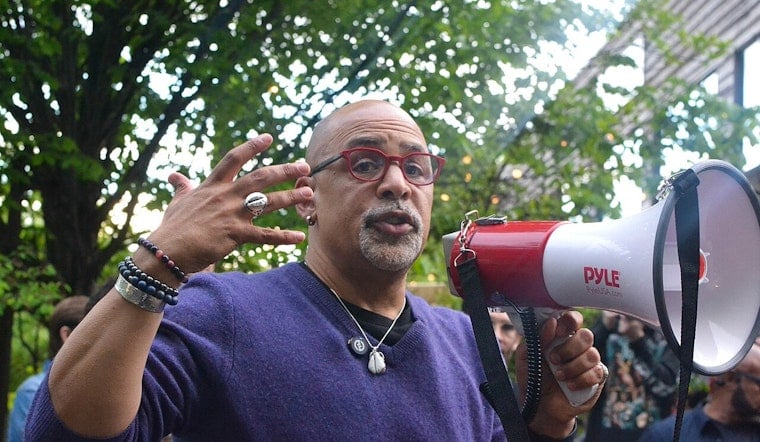
State Rep. Chris Rabb is not easing into his post-primary victory lap. Fresh off a decisive win in the Democratic primary for the 3rd Congressional District, he is openly pushing for a shake-up of Philadelphia's Democratic Party, calling for changes to both party leadership and the way the city draws its political maps.
Rabb insists this is not personal beef with the old guard but a structural fight. He argues that outdated ward lines and internal rules concentrate power in a handful of hands and weaken real neighborhood representation.
In a co-sponsorship memo sent to House members on June 5, 2026, Rabb outlined legislation, formerly known as HB 2925, that would amend the Pennsylvania Election Code to require the City of Philadelphia to include political wards in its regular decennial reapportionment. It would also have City Council convene a nonpartisan commission to present new ward maps, according to the Pennsylvania House of Representatives. The memo notes that Philadelphia "has not updated ward boundaries in over 50 years" and calls for a transparent process that would finally bring ward lines into line with population shifts shown by the census.
Rabb's push lands at a sensitive political moment. He won the Democratic primary for the 3rd Congressional District on May 19 with roughly 44 percent of the vote, as reported by Axios. At the same time, the party's rank and file are in the middle of their own reshuffling. Committeepeople chosen in the May primary are reorganizing their wards now, and ward leaders are set to meet in June to pick the city Democratic chair.
Longtime chair Bob Brady says he is not ready to hand over the gavel. He has announced that he plans to run for another term and told NBC10 Philadelphia that the party's progressive wing "has a major role" to play in what comes next.
Why the Ward Map Matters
Philadelphia's ward structure is the skeleton of its political machine, and it has barely changed since 1966. That year, a citywide redivision created 66 wards, the basic layout that still exists. Because there has been no regular reapportionment, some wards are now significantly over or under populated.
City & State Pennsylvania has detailed how the interlocking system of wards and divisions channels local political power, and how the rules for open versus closed wards determine who gets a real say in endorsements and internal decisions. Reformers argue that updating the lines would make committee votes, endorsements, and party staffing better reflect today's neighborhoods rather than decades-old boundaries that no longer match where people live.
What Comes Next
For Rabb's proposal to become more than talking points, it will need to move in Harrisburg. His memo envisions a process that ties together state lawmakers and City Council, with Council convening a nonpartisan commission to draw ward plans. He has asked House colleagues to sign on as co-sponsors, according to the Pennsylvania House of Representatives.
Meanwhile, the party's internal calendar is ticking faster than any legislative timetable. Newly elected committeepeople are in the process of reorganizing their wards, and ward leaders will soon gather to select the party chair, according to the Committee of Seventy. Local reporting notes that Rabb has told reporters he plans to reintroduce the ward reapportionment measure and has urged committeepeople elected on May 19 to use their new positions to push for change, as reported by Chestnut Hill Local.
Political Stakes For The Machine
All of this sets up a stress test for Philadelphia's Democratic establishment. The question is whether the party adapts to a new generation of activists and committeepeople or digs in around long standing habits that have defined city politics for half a century.
Brady's promise to "reach out" to younger, progressive voters, alongside Rabb's very public call for structural reform, hints at the possibility of a truce. The real fight, though, is likely to unfold in quieter rooms. Ward reorganizations happening now, followed by any legislative battle over ward reapportionment, could shift where real power sits inside the party.
For the moment, the story starts at the ward level this month. If Rabb's bill moves, the next chapters will play out in City Council and the state legislature, where Philadelphia's insider map could finally face an official redraw.





