

























































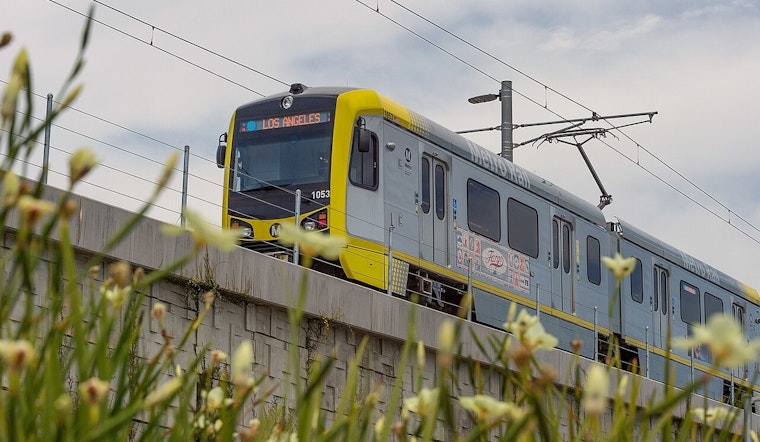
After years of talk and shifting plans, Metro has quietly hit a major milestone for the long-promised E Line Eastside extension, releasing a federal Environmental Assessment that locks in a roughly 4.7‑mile starter segment to Greenwood in Montebello. The document sketches a mostly grade-separated route, with several miles of tunnel, a short aerial section, and a street-level terminus, and kicks off a key public review period with hearings set for this month.
What the EA Lays Out
Metro's Environmental Assessment centers on a single Build Alternative that would tweak about 0.4 miles of existing track and add roughly 4.3 miles of new guideway east of Atlantic Station, for a total of 4.7 miles. The plan would take the existing Atlantic/Pomona stop and move it underground, add three new stations farther east, and vet three possible sites for a maintenance and storage facility in Montebello and Commerce. All of those engineering and alignment details are spelled out in the federal document filed with the California State Clearinghouse (CEQAnet).
Riders and Operating Needs
The EA "anticipates approximately 7,550 total weekday station boardings by 2050," with station forecasts showing Greenwood as the busiest stop on the extension (CEQAnet). To cover that demand, Metro says it will need several additional three-car trains to run the expanded E Line. The assessment backs this up with station-by-station boarding projections and operating assumptions used to size the future fleet.
Money and Schedule
According to reporting on the EA, Metro currently has about $3.96 billion secured against an estimated $7.90 billion price tag, leaving roughly $3.94 billion still to be cobbled together from state and federal programs (Urbanize LA). The money on hand largely comes from local sales taxes, with some state grants already in the mix, while the rest is aimed at competitive pots such as New Starts and the Transit and Intercity Rail Capital Program. On paper, Metro is targeting an opening for the initial Montebello segment sometime between 2035 and 2037, with that window hinging on how quickly the remaining funding comes through (Urbanize LA).
Public Hearings and How to Weigh In
Metro says "the NEPA Environmental Assessment (EA) is now available for review and comment by Friday, June 26, 2026" and has lined up in-person and virtual hearings in early June to walk the public through the proposal. Printed copies are available at several local libraries and at Metro's Dorothy Peyton Gray Transportation Library, and the full EA can be viewed and commented on through the agency's PlanEngage portal. Comments are being accepted online, by email and by mail as part of the 30-day federal review window (Metro).
Why the Corridor Changed
Older versions of the Eastside extension included a second branch running along the SR-60 freeway, but that idea was eventually deemed infeasible on both cost and operational grounds and dropped from active planning. Coverage tracking the project shift notes that money once eyed for the SR-60 alignment has since been redirected to other San Gabriel Valley transit efforts. Metro's current approach - build the 4.7‑mile initial operating segment to Montebello now and leave the Whittier leg for a later phase - reflects those financial and engineering tradeoffs (Streetsblog LA).
Next Steps
The comment period runs through June 26; after that, Metro will sift through the feedback, coordinate with the Federal Transit Administration to wrap up the NEPA process and, if warranted, pursue a Finding of No Significant Impact before turning in major federal funding applications. Behind the scenes, staff are already pushing ahead on preliminary engineering and outreach, with plans to brief the Metro Board on the outcome of the NEPA work in spring or summer 2026, followed by design milestones and formal grant bids (Metro). Construction on the initial segment is currently programmed to start in 2029 under Measure M, while the agency continues chasing state and federal grants to plug the remaining multibillion-dollar funding gap (Metro).





