

























































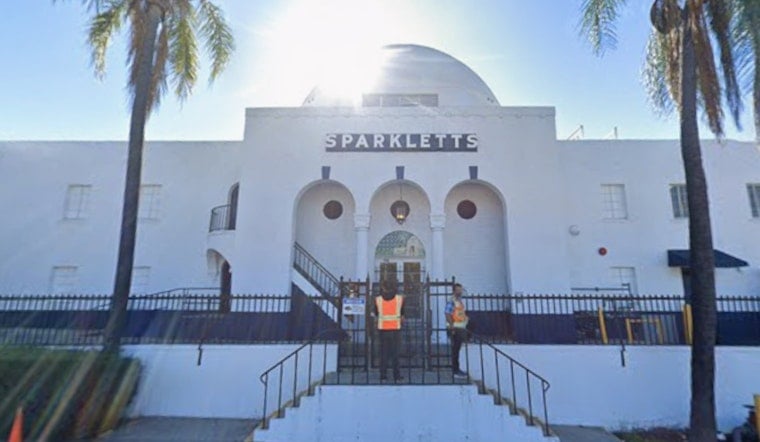
The Sparkletts bottling plant straddling the Eagle Rock and Highland Park line has officially landed on the City of Los Angeles’ list of Historic‑Cultural Monuments, a move that slows any rush to redevelop the site and gives preservationists a crucial breather. The 1929 Moorish‑Revival complex, once a busy bottling operation, has been quiet since Sparkletts ended production there in 2025. The long game is still uncertain: the property is privately owned, and saving it will take far more than a handsome plaque on the wall.
On June 24 the City Council voted to designate the site a Historic‑Cultural Monument. The label “does not guarantee that the building cannot be demolished” but lets the city delay demolition for up to 360 days to “allow for time to preserve the monument,” according to the Los Angeles Times. The move followed months of neighborhood lobbying and a formal nomination from the Eagle Rock Valley Historical Society. Advocates say that delay window is everything, because it is the only shot they have to line up money or a buyer interested in reuse instead of a teardown.
The Council’s decision came after a 3‑0 recommendation from the Cultural Heritage Commission in April and a unanimous Planning and Land Use Management Committee vote on June 9, as outlined by the Los Angeles City Clerk. The official case number is CHC‑2026‑332‑HCM, and the PLUM report lists the owners as Sparkletts Drinking Water Corporation and Foremost Water Corporation. The matter is filed under Council File 26‑0623 with the Los Angeles City Clerk. With the paperwork now in motion, city staff and neighborhood groups have only a limited window to put real preservation or adaptive reuse proposals on the table.
Architect Richard D. King designed the main structure in 1929 in a showy Moorish‑Revival style, with domes, arched portals and decorative tilework that give the complex a mosque‑like presence, according to the L.A. Conservancy. The plant once drew water from nearby subterranean springs, and its scale and ornamentation turned it into a neighborhood landmark. Sparkletts’ local closure in 2025 followed a round of corporate consolidation: the brand is now part of Primo Brands after a 2024 merger, per the company’s release.
Neighbors and preservationists moved quickly once the shutdown hit, especially after part of the site briefly appeared on commercial listing platforms and the company removed its largest sign last summer. “We’ve always had an eye on the building because it’s such an icon in the community,” Frank Parrello, landmarks chair at the Eagle Rock Valley Historical Society, told the Los Angeles Times. For advocates, the new status is a tactical win: it stops the clock for a while, but it does not pay for restoration or magically produce a preservation‑minded buyer.
What the designation actually does
Historic‑Cultural Monument status triggers extra scrutiny for any permit to alter, relocate or demolish the structure, and it automatically pauses demolition while alternatives are explored. Under the City’s Cultural Heritage rules the Commission can impose an initial 180‑day stay and then ask the Council for another 180 days, giving up to roughly a year to explore preservation options, according to city planning materials. During that time, California Environmental Quality Act protections kick in, and advocates get a formal seat at the table to negotiate with the owner over potential outcomes.
Who could step in — and what it could become
From here, several paths are theoretically on the board. A preservation nonprofit or some form of public‑private partnership could step up to adapt the plant for community use, housing or creative office space; the L.A. Conservancy and local groups have pointed to similar industrial‑to‑mixed‑use conversions as realistic models. Incentives such as tax tools and technical assistance exist to soften the financial hit of rehabbing a quirky industrial landmark, but they only help if the current owner or a new buyer actually wants to save the building.
If a public agency, nonprofit or preservation‑minded developer does come forward, the plant’s large, open interior is the kind of layout that typically makes adaptive reuse possible. For now, though, the new status mainly buys the neighborhood some breathing room. Saving what locals call the Taj Mahal of Lincoln Avenue will still take money, coordination and an owner who sees long‑term value in the old bottling plant’s architecture and bones. In the months ahead, city staff, neighborhood advocates and the property owners will decide whether the next chapter is preservation, reuse or a slow, contentious march toward demolition.





