

























































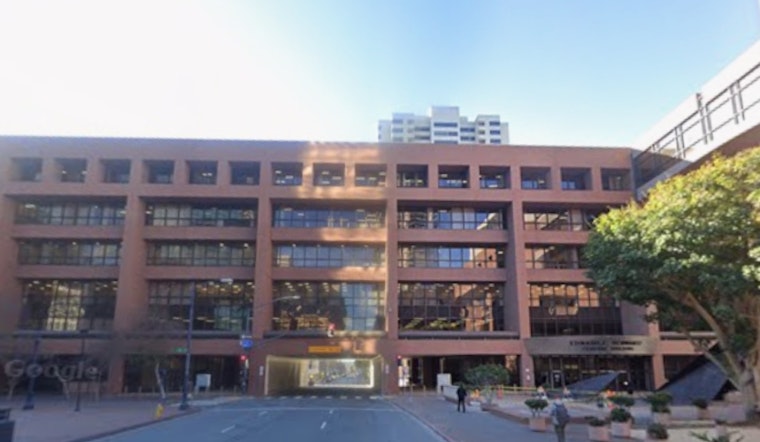
A bargain outlet steps from the Otay Mesa Port of Entry was allegedly sitting on top of a cartel tunnel that looked more like an underground train line than a border trick. Federal agents say they arrested four men after uncovering a nearly 2,000-foot passage beneath the store, complete with lighting, ventilation and an electric rail system. Inside that operation, investigators say, they found more than a ton of suspected cocaine.
In yesterday's press release, the U.S. Attorney’s Office for the Southern District of California said the tunnel runs about 1,933 feet, drops roughly 55 feet below ground and includes reinforced walls with sections up to 4.5 feet high. Prosecutors identified the four defendants as Gregorio Epifanio Hernandez Lopez, Jose Jimenez, Brandon Escalante Sandoval and Antonio Cortez, and said they face charges that include conspiracy to distribute controlled substances and tunnel-related offenses. The announcement capped months of surveillance by a Homeland Security Investigations Tunnel Task Force, according to the U.S. Attorney’s Office for the Southern District of California.
“For these defendants, it wasn’t a light at the end of the tunnel. It was lights and sirens,” U.S. Attorney Adam Gordon said, leaning into the obvious punchline. HSI’s acting special agent in charge, Kevin Murphy, called the discovery a “significant blow” to the Jalisco New Generation Cartel. Authorities say the HSI Tunnel Task Force watched the Buy 4 Less storefront from December 2025 through May 2026 and intercepted what prosecutors describe as the suspects’ first attempted shipment into the United States on May 29. Traffic stops and K9 alerts that same day led investigators to the tunnel’s exit beneath the store, per the U.S. Attorney’s Office.
What investigators seized
According to federal court filings, agents collected 851 packages of suspected cocaine weighing a combined 1,029.6 kilograms, or about 2,270 pounds. On the street, investigators estimate the bulk value at roughly $45 million. The haul turned up after coordinated traffic stops of vehicles tied to the suspected tunnel operation and searches at the Buy 4 Less storefront and a nearby mechanic shop, as reported by KGTV/10News.
How investigators say it worked
Prosecutors say the Buy 4 Less location was more than a place to pick up discount appliances and luggage. On the surface, it sold appliances, luggage and assorted goods. Behind the scenes, people described as "employees" allegedly drew attention by hauling oversized suitcases around and loading deep freezers into vans and trucks in ways that did not quite match a normal retail operation.
Those movements, along with behavior that agents interpreted as counter-surveillance, prompted investigators to tail vehicles leaving the store to a nearby mechanic shop. Officers later pulled several vehicles over, where K9 teams alerted to what authorities say were concealed narcotics, helping to confirm that something much bigger was moving beneath the storefront.
Legal fallout
The complaint charges Hernandez Lopez with constructing, financing or using an unauthorized tunnel under 18 U.S.C. § 555, along with importation and distribution offenses under 21 U.S.C. §§ 841 and 846. Some of those counts carry potential maximum sentences of life in prison and fines of up to $10 million. According to the U.S. Attorney’s Office, the case will be prosecuted in San Diego, and the four defendants were scheduled to appear for arraignment before a magistrate judge.
Why this matters
Cross-border tunnels have become a recurring headache for law enforcement in the San Diego corridor, where federal officials have found dozens of underground passages over the years. In 2025, authorities shut down another lengthy tunnel equipped with its own rail and ventilation system, according to the Los Angeles Times.
The Otay Mesa seizure underscores how interagency teams, including HSI, U.S. Border Patrol, the Drug Enforcement Administration and local sheriff’s deputies, work in concert to cut off large shipments before they can filter into communities. In this case, the alleged smuggling route might have been underground, but prosecutors clearly want the message to land right at street level.





