

























































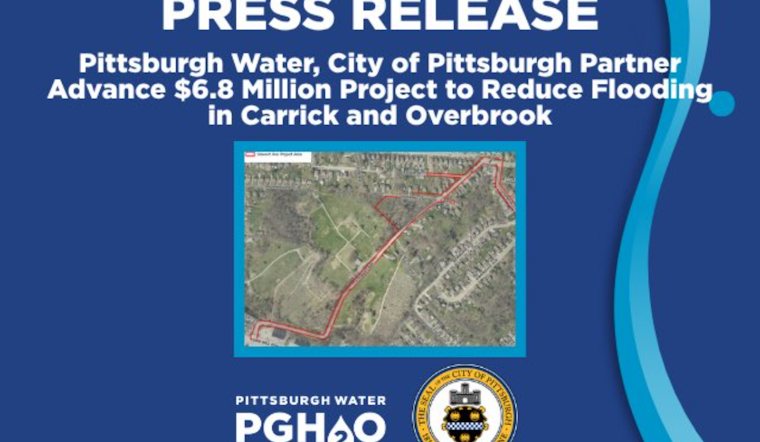
The City of Pittsburgh and Pittsburgh Water are teaming up on a $6.8 million infrastructure push aimed squarely at chronic flooding and beat-up streets in Carrick and Overbrook. Announced on Thursday, the package focuses on stormwater fixes in the Saw Mill Run watershed and pairs green infrastructure with more traditional drainage, street, and sidewalk upgrades in spots where water routinely pools up.
Today, the City of Pittsburgh and @pgh2o announced a NEW $6.8 million infrastructure project that will improve stormwater management, reduce flooding risks, and deliver roadway and sidewalk improvements in the Carrick & Overbrook neighborhoods.
— City of Pittsburgh (@Pittsburgh) June 11, 2026
See more: https://t.co/US7k0vY0fM pic.twitter.com/RE9xzv0o4G
What Officials Announced
According to the City of Pittsburgh, the $6.8 million effort "will improve stormwater management, reduce flooding risks, and deliver roadway and sidewalk improvements" in Carrick and Overbrook, with Pittsburgh Water (PGH2O) named as the delivery partner. The city has not yet identified a contractor or construction schedule in its announcement, and it is steering residents to utility channels for the fine print. Officials are framing the work as a targeted neighborhood investment focused on drainage fixes and surface restoration.
Why Carrick And Overbrook?
Pittsburgh Water’s project information highlights ongoing stormwater planning in Carrick, including the Stewart Avenue stormwater improvement, which the utility notes drains to the Saw Mill Run stream, which is overwhelmed during most rain events. Detention systems and green infrastructure are listed as priorities in that watershed, where aging drainage and heavy runoff have contributed to repeated street and basement flooding. Those technical issues are a big part of why city leaders are zeroing in on Carrick and Overbrook for this round of spending. Pittsburgh Water
How This Fits Citywide
The move lines up with broader stormwater planning that puts the Saw Mill Run watershed near the top of the list for community-driven green infrastructure and detention projects. That work is part of a larger push to cut flood risks and improve water quality across priority sewersheds. Community engagement, ambassador programs, and neighborhood surveys have helped shape design decisions and potential sites, with officials saying the goal is to limit street flooding, basement backups, and polluted runoff into local streams. Grounded Strategies
Next Steps And Timeline
Pittsburgh Water’s listing for the Stewart Avenue work currently labels the project status as "On Hold" with a start date of "TBD," which signals there is still design, permitting, and coordination to complete before any crews show up. The city’s social media announcement did not include a project-by-project timeline for the full $6.8 million package, instead telling residents to check utility project pages for updates. Detailed maps, contacts, and future notices are available for those who want to track progress as it moves forward. Pittsburgh Water
What Neighbors Should Expect
Stormwater and street upgrades typically bring temporary lane changes, parking restrictions, sidewalk closures, and staggered restoration, and officials say full street and sidewalk restoration is planned so that finished surfaces follow the underground work. There is not yet a specific detour or disruption plan attached to this announcement, so neighbors are being urged to keep an eye on official updates for construction notices and no-parking alerts. The city’s post and the utility’s project pages are expected to be the first places where schedules and location-specific notices will appear. City of Pittsburgh





