

























































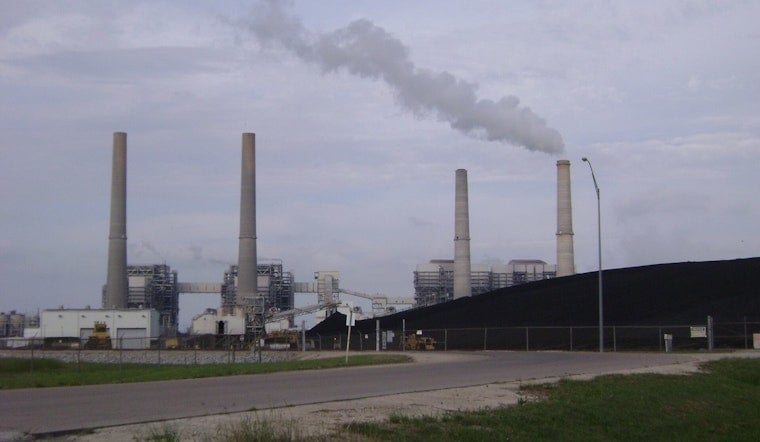
Researchers say a single coal-fired power plant just outside Houston is acting like a regional cloud machine, sending a plume of storm-seeding particles over downtown and far beyond the city limits.
Scientists at the Scripps Institution of Oceanography traced cloud-forming aerosols back to the W.A. Parish Generating Station, a major coal facility southwest of Houston. Using aircraft measurements and ground sensors, they tracked the plant’s emissions over the city center and more than 110 kilometers downwind. The particles they found are roughly the same size as those associated with respiratory illness, which links the region’s storm behavior to familiar air-quality concerns.
According to the Journal of Geophysical Research: Atmospheres, a paper published June 28 singles out the Parish plant as a disproportionately large source of cloud-condensation nuclei (CCN) for greater Houston. Lead author Greg Roberts and colleagues stitched together data from 24 research flights in May and June 2022, mobile ground aerosol platforms, and U.S. Department of Energy radar. As reported by UC San Diego Today, the work was funded by the National Science Foundation and the U.S. Department of Energy.
How Researchers Mapped the Plume
The observations were collected under the ESCAPE field campaign, which coordinated aircraft sampling with a network of ground stations across coastal Texas. Researchers flew a Convair CV-580 equipped with CCN counters and other instruments to sample clouds and updrafts in and around the Parish plume, as detailed in the Journal of Geophysical Research: Atmospheres.
By pairing those in-flight measurements with ground-based aerosol data and federal radar, the team could pull apart the power plant’s signature from the crowded mix of particles produced by traffic, refineries, and shipping. That separation is what allowed them to identify Parish as a dominant local source of cloud-forming particles rather than just one more industrial emitter in the background.
Why the Finding Matters for Storms and Health
“Cloud-forming particles are also the size of particles that go deepest into the lungs,” Roberts said, according to UC San Diego Today. When a single nearby source pumps out large amounts of CCN, it can boost the number of droplets in a cloud and change how bright that cloud appears. In polluted, convective environments, the authors note, those shifts may influence storm intensity and how and where rain is released.
The study stops short of tracking specific health outcomes, but the overlap in particle size between cloud seeds and harmful fine pollution gives regulators and public health officials a very concrete target for follow-up monitoring and analysis.
Local Context and What Comes Next
The W.A. Parish Generating Station is one of the largest conventional power plants in the United States and is owned by NRG, according to Global Energy Monitor. Its emissions have already drawn community scrutiny and permit reviews in recent years, and the new source-apportionment evidence is likely to become part of those conversations.
The authors say their high-resolution data can help modelers better capture how aerosols and clouds interact over Houston and highlight where emissions controls at a single facility might deliver outsized benefits for both air quality and cloud behavior.
This paper is part of a broader wave of ESCAPE-era studies aimed at shrinking the uncertainty around how particles influence clouds and climate. The researchers call for targeted monitoring and updated emissions inventories so that policymakers can translate this single-source finding into specific air-quality and climate decisions rather than treating it as just an academic curiosity.





