

























































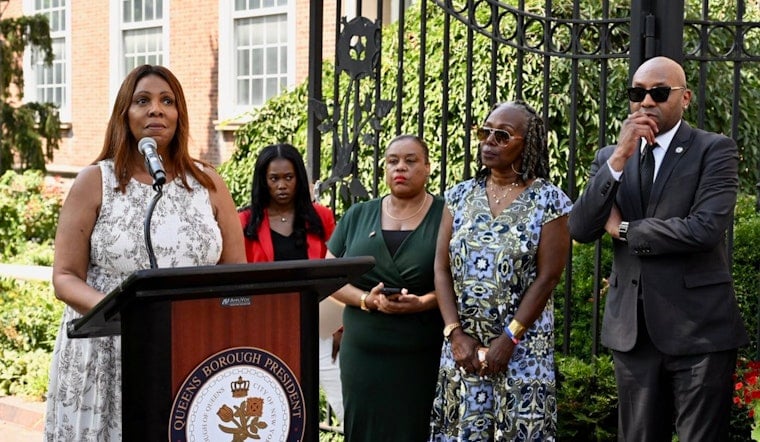
New York Attorney General Letitia James took her fight over immigration straight to the front steps of Queens Borough Hall in Kew Gardens on Monday, June 29, 2026, ripping into the U.S. Supreme Court’s recent decision that clears the way to end Temporary Protected Status for Haitian and Syrian nationals. Flanked by community leaders, advocates, and neighborhood residents, James called the ruling a betrayal and promised to keep backing families who have built roots in New York. Speakers warned that losing TPS could derail jobs, housing and kids’ schooling for thousands of local residents, tying the Queens rally to a wave of protests that has followed last week’s court decision nationwide.
I rallied on the steps of Queens Borough Hall to condemn the Supreme Court's decision to strip TPS from our Haitian and Syrian neighbors. New York's Haitian and Syrian communities are a crucial part of making our state what it is today. I’ll never stop fighting for them. https://x.com/i/status/2071729893184811018
— Letitia James (@newyorkstateag) June 29, 2026
James’s Message And Queens Crowd Reaction
In a post on X, James said she “rallied on the steps of Queens Borough Hall to condemn the Supreme Court's decision” and pledged, “I’ll never stop fighting for them,” referring to Haitian and Syrian TPS holders. Her office followed up after the June 25 ruling with a formal statement labeling the decision “a betrayal of our values” and stressing that New York had joined other states in challenging the move, according to the Office of the New York State Attorney General.
Rally organizers told attendees to get plugged in quickly with neighborhood legal clinics and social‑service providers so families can prepare for sudden changes to their status. Several participants said they were already lining up outreach to workers and students who may now be facing deadlines on their ability to work, stay housed, or remain enrolled in school.
What The Supreme Court Actually Did
On June 25, the Supreme Court handed down a 6–3 opinion that lets the administration move ahead with ending TPS for Haiti and Syria and holds that, in general, federal courts cannot second‑guess Department of Homeland Security decisions on non‑constitutional grounds, according to the Supreme Court. The ruling wipes out a key legal barrier and directly affects an estimated 350,000 Haitian TPS holders and about 6,000 Syrians, according to reporting by AP.
Employers and immigration attorneys had previously been advised to treat July 1, 2026 as a placeholder reverification date for Form I‑9s while the litigation played out, per guidance summarized by the American Immigration Lawyers Association. The decision leaves the door open for narrow constitutional challenges but sharply curtails the chance for broader court relief.
Local Fallout And Next Moves In New York
New York hosts one of the nation’s largest Haitian communities, and organizers say that reality is shaping their response. They are prioritizing free legal help, emergency housing assistance and worker outreach as deadlines approach. James, who has led amicus briefs opposing TPS terminations, reiterated that her office will “continue to stand with immigrant communities,” according to the Office of the New York State Attorney General.
City agencies and immigration nonprofits are coordinating intake systems and surge staffing to handle what they expect will be a crush of calls and walk‑ins, advocates at the rally said. For a deeper dive into how the decision gave the administration a green light to strip TPS, see earlier coverage from Hoodline.
What Advocates And Lawmakers Are Saying
Members of the Congressional Black Caucus and other federal lawmakers have slammed the ruling and urged Congress to step in with protections for TPS recipients, according to a CBC statement. Civil‑rights groups have likewise denounced the decision as devastating and pressed for rapid action on Capitol Hill along with expanded local support networks, per a statement from the ACLU.
Legal analysts note that, even with the Supreme Court’s limits, plaintiffs can still pursue constitutional challenges in lower courts while administrative deadlines tick closer. Over the next several weeks, the real test will be whether Congress, targeted new lawsuits, or a rapid expansion of local services can soften the immediate impact of the ruling on families in New York and across the country.



