

























































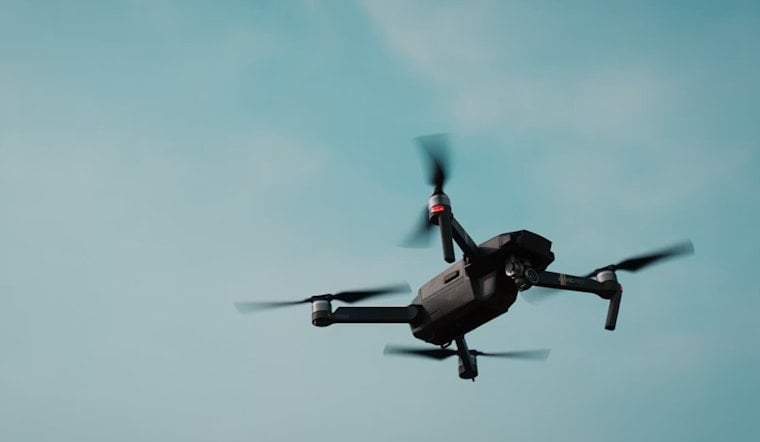
Detroit's flashiest debut this week was not a concept car. It was a robotic combat vehicle with a turreted laser designed to burn small drones, rolling onto the floor at the Reindustrialize summit in the heart of downtown. The device, built around a directed-energy counter-UAS package that Aurelius Systems calls Archimedes, was put on public display at Hudson's Detroit during the summit's sessions last Tuesday and last Wednesday. The appearance shoved a live debate over autonomous weapons into a conference that usually sticks to supply chains and factory tech.
Show Floor Debut
According to The Defence Blog, Aurelius Systems mounted its Archimedes autonomous directed-energy counter-drone system onto a robotic combat vehicle at Reindustrialize 2026, showing off the hardware in partnership with American Rheinmetall and EV startup Harbinger. The display's banner highlighted machine vision, radar-based tracking, and modular power interfaces, but the exhibit did not share specifics on laser power, engagement range, or vehicle weight. The outlet noted that the public showing signals a move past lab-only prototypes and into integrated, vehicle-mounted demonstrations.
What the Company Says
According to Aurelius Systems, Archimedes combines high-power fiber lasers with advanced optics, machine-vision sensors, and AI autonomy to detect, track, and neutralize small unmanned aircraft "in seconds." The system is designed to pull power from the grid, generator, or battery sources. The company also emphasizes a commercial off-the-shelf architecture that it says is meant to speed production and fielding. Aurelius has added that it is moving to expand domestic manufacturing of laser components to support scaling.
Recent Pentagon Testing
There are indications that Archimedes is not just a trade-show prop. The Defense Post reported that the system recently completed live trials for the Pentagon at Camp Atterbury in Indiana in mid-June, engaging more than 20 quadcopters and several Army-provided UAS as part of a broader 60-platform evaluation. That exposure to military targets marks a step between controlled lab work and the kind of demonstrations that can lead to procurement talks. Industry observers say those experiments sit inside a wider push to test directed energy for counter-UAS missions.
Where This Fits In
Directed-energy weapons have been edging from demonstration pieces into operational trials across the services. The Navy's HELIOS program and other shipboard lasers have already been tested at sea, as covered by Naval News. The Army's short-range air defense experiments with directed energy are also moving forward, according to Janes, putting Archimedes into a crowded and fast-evolving field rather than a one-off curiosity.
Why Detroit?
The Reindustrialize summit bills itself as a gathering aimed at rebuilding American industrial capacity, and this year's agenda included panels on defense supply chains and hardware scale-up. Reindustrialize lists participants ranging from defense primes to EV and robotics startups, a mix that helps explain why a laser-armed robot rolled into the mix. For Detroit, which is pitching itself as the country's industrial comeback story, the overlap between commercial EV chassis makers and military suppliers is part of the sales pitch for future contract work and factory investment.
Legal and Ethical Questions
Weapons that can use autonomy to select and engage targets raise policy and legal concerns. The Department of Defense's 2023 update to DoD Directive 3000.09 requires such systems to be designed so commanders and operators can exercise "appropriate levels of human judgment" and to undergo senior-level review. DoD laid out those safeguards in a January 25, 2023, release. Civil-society organizations, including Human Rights Watch have pushed for stricter limits or moratoria on fully autonomous targeting and have warned of accountability risks for civilians if human oversight is too thin.
Archimedes' public debut in Detroit was eye-catching but also opaque. The exhibit and company materials did not disclose laser power, effective engagement ranges, or vehicle mass, leaving experts to judge performance claims only after further testing and official evaluations. The Defence Blog pointed out the lack of specific performance data, while Aurelius' own newsroom has focused on recent demonstrations and its push to build U.S. laser-component capacity. As the technology moves from demos into Pentagon trials and potential contracts, Detroit's suppliers and plants may find themselves pulled into the next industrial push to field directed-energy defenses.





