

























































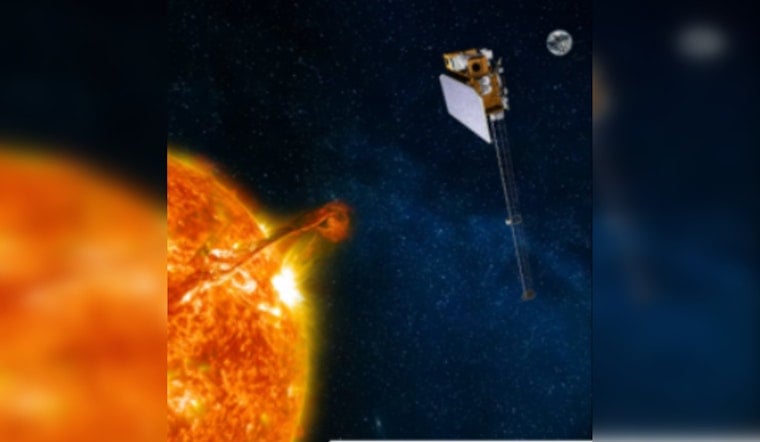
NOAA's SOLAR-1 satellite is officially on the job this week, giving forecasters faster heads-ups on solar storms and offering aurora chasers clearer short-term signals on when to grab the car keys and head out. Parked far upstream of Earth, the spacecraft will stream near-real-time views of the coronal mass ejections and solar wind that drive geomagnetic storms. For power grid operators, airlines and GPS providers, that extra lead time can translate into precious minutes to take protective action.
According to NOAA's Space Weather Prediction Center, SOLAR-1, formally Space Weather Observations at L1 to Advance Readiness-1, is now stationed at the Sun-Earth Lagrange point roughly one million miles from Earth and is the agency's first dedicated, continuous space-weather observatory. The observatory wrapped up its checkout and validation program before entering operational service this week.
As reported by Axios, SOLAR-1 can deliver images of coronal mass ejections (CMEs) to forecasters at NOAA's center in about 30 minutes, a major speed-up from the roughly eight hours it can take for comparable imagery from older instruments. Axios also notes the spacecraft completed an eight-month testing cycle following its September 2025 launch.
“SOLAR-1, America’s first satellite designed exclusively for continuous, operational space weather observations, represents a major advancement in our defense against solar storms,” NOAA's Office of Space Weather Observations said in agency materials. The agency adds the faster observations will support “timely watches, warnings, alerts, and decision support” before storms affect critical systems on the ground and in orbit.
How The Instruments Help Forecasters
The spacecraft carries a coronagraph along with a suite of in-situ sensors that measure the magnetic field and particle properties of the solar wind. That lets forecasters see both the structure of a CME and the stream it sends toward Earth. According to a mission overview from the prime contractor, those instruments were selected to deliver low-latency imagery and plasma data that plug directly into operational forecasting systems. Used alongside other satellites, SOLAR-1 measurements should sharpen predictions of when a storm will arrive and how strong it is likely to be.
Why Aurora Watchers Could Get Better Leads
Faster CME imagery and continuous solar-wind monitoring tighten the wide uncertainty window that often makes aurora forecasts feel like a coin toss. A CME's magnetic orientation, which controls whether charged particles can punch through Earth's magnetosphere, can flip a display from “possible” to “likely.” Recent coverage from Hoodline notes that short-term viewline maps and K-index products are the primary tools people use to decide whether a sighting is worth the late-night drive, and those products stand to benefit from quicker upstream data. In practice, that points skywatchers toward watching hourly and sub-hourly updates rather than banking on multi-day outlooks.
Industry outlets covering the activation report that NOAA plans to feed SOLAR-1 data into the same operational pipelines used by utilities, aviation operators and launch controllers so those customers can take protective measures earlier. Satellite makers and analysts also highlight that the mission helps replace aging upstream platforms and supports continuity of the space-weather observations that underpin many everyday technologies.
For now, the most tangible perk for most readers is simple and practical: the night a strong CME is expected, keep a close eye on short-term aurora forecasts and NOAA's operational products. Faster upstream imagery will not guarantee a social-media-ready light show, but it should cut down on guesswork, and that extra cushion of time can matter a lot to both infrastructure managers and anyone hoping to catch the lights.





