

























































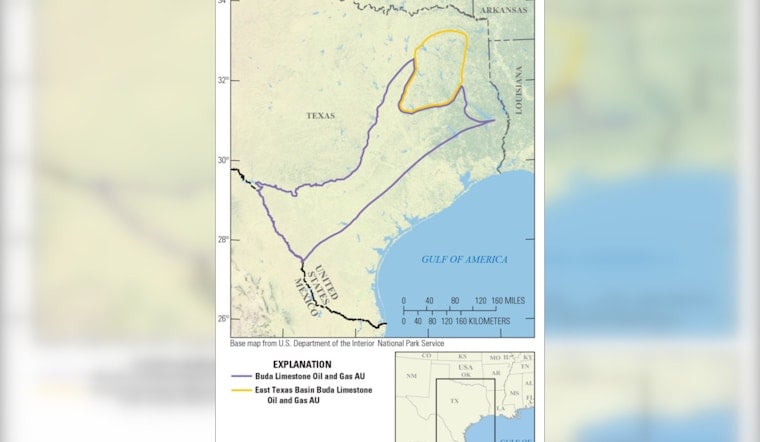
There is confirmed oil and gas under parts of central Texas, including beneath and around Austin, but nobody is breaking out the “black gold” banners just yet. A new federal assessment says the Buda Limestone holds more fuel than previously mapped, offering fresh detail for landowners, drillers, and local officials rather than a ticket to the next big boom.
What the USGS Found
In a June 24, 2026, assessment, the U.S. Geological Survey estimated a mean of about 12 million barrels of technically recoverable oil and roughly 184 billion cubic feet of gas still undiscovered in the Buda Limestone. Since production first started around 1930, the Buda has already given up about 204 million barrels of oil and roughly 287 billion cubic feet of natural gas.
The agency points out that, in the context of national energy use, those numbers are on the small side. The update is part of its long-running effort to map where future exploration might make sense, not a promise that a rush of new wells is about to follow.
Where the Buda Sits in Central Texas
Locally, KVUE reports that the Buda Limestone is exposed at and under parts of the town of Buda and stretches beneath neighborhoods and ranchland to the northeast and southwest of Austin. That footprint makes the new numbers very relevant for a wide swath of central Texas property owners, from suburban cul-de-sacs to cattle country.
KVUE’s June 24 coverage breaks down the federal science in local terms, spelling out what the added subsurface detail might mean for residents, county officials, and anyone whose land sits over the formation. The takeaway is that a technical federal study could quietly influence zoning talks, lease negotiations, and dinner-table conversations across the region.
Geology, Limits, and the Role of the Eagle Ford
Geologically, the Buda does not work alone. The USGS notes that the Eagle Ford Group, a prolific shale unit that sits above the Buda, is the primary source rock feeding oil and gas into the limestone. In its release, the agency also cautions that “the Buda Limestone has little remaining undiscovered oil or gas, indicating a need for new resources,” a reminder that this is a mature play, not a fresh frontier.
The bureau stresses that its assessments are meant to provide geologic context for more detailed exploration planning, not to forecast immediate drilling. In other words, this update fine-tunes the underground map more than it flips a switch for new rigs.
How Industry Might Respond
Modern techniques such as horizontal drilling and hydraulic fracturing, which turned the Eagle Ford into a major producer, have also made stacked carbonate targets like the Buda more appealing. Outlets that follow petroleum geology note that stacked pay zones can reduce development costs, since operators can work multiple formations from the same surface pad.
For background on how the Eagle Ford and Buda interact and why companies sometimes chase layered zones together, see Geology.com. Whether this particular assessment turns into new drilling permits will depend on oil and gas prices, pipeline capacity, and each company’s appetite for squeezing more out of older rocks.
For now, the USGS update mainly reshapes the mental map for Texas landowners, drillers, and regulators. It narrows down where additional oil and gas might still be hiding and hands local officials one more data point to weigh as they juggle energy development, growth, and quality-of-life concerns. Expect interest to show up first in planning documents and lease talks long before anyone sees a rush of new steel in the ground.



