

























































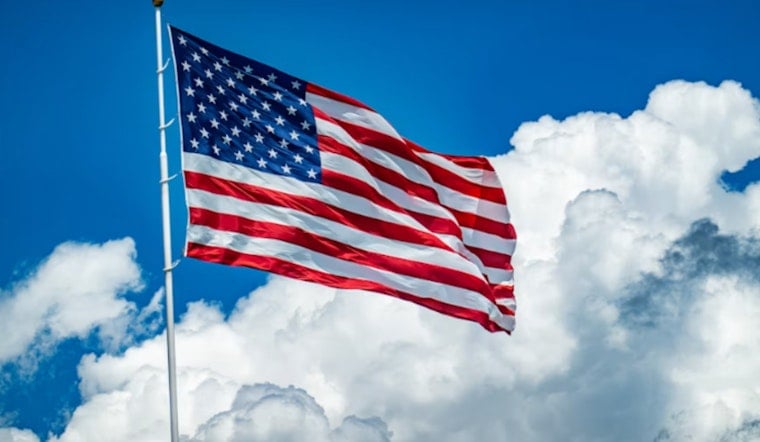
Most Black Americans say they never fly the U.S. flag, a new national poll finds, laying bare how one piece of fabric can carry wildly different meanings depending on who you ask as the country inches toward its 250th birthday. Only about three in 10 Black adults report ever displaying the Stars and Stripes at home, compared with roughly half of white and Hispanic adults. That split lines up closely with age and party: older white Republicans are among the most likely to fly the flag, while younger Democrats and many Black respondents are among the least inclined to put it out.
About half of U.S. adults say they display the flag at home either year-round or on holidays, but that topline number masks a jumble of views, according to AP. The outlet reports that 47% of adults see the flag as more unifying than divisive, 36% say it is neither, and 16% call it more divisive. The reporting also weaves in interviews from cities like Detroit and Minneapolis that put names and faces to those statistics.
The findings come from an AP-NORC poll of 2,596 adults conducted in April using NORC's AmeriSpeak probability panel, with an overall margin of sampling error of ±2.6 percentage points for the full sample, according to the release.
Race, party and age shape flag habits
The poll highlights sharp splits by party and generation. About six in 10 Democrats and independents say they "never" fly the flag, and 75% of Democrats under 45 fall into that camp, while roughly seven in 10 Republicans report flying it at least on holidays, per AP. Americans 60 and older are also far more likely than younger adults to display the flag on a regular basis. Together, those patterns suggest that putting up Old Glory now often doubles as a signal of political identity as much as a gesture of civic pride.
Voices on both sides
The survey reporting folds in personal stories that explain why people land where they do. In Detroit, Jerry Esters said he flies multiple flags outside his home as a tribute to the opportunities his family struggled to secure. By contrast, 79-year-old Yvonne Pistochini said there is "no scenario" in which she would fly the Stars and Stripes at her house because, in her view, the country has not lived up to its promises. Those perspectives capture how the same flag can represent hard-won pride for some and deep disappointment or hurt for others.
What experts say
Historians and scholars point to a long history in which national symbols have been wielded both to welcome and to shut people out. Dartmouth historian Matthew Delmont has noted that many Black Americans "see the flag as a symbol of both inclusion and exclusion," pointing out that it has at times been used to promote exclusionary versions of patriotism. Writers and activists likewise argue that, for some people, the flag is less a simple emblem of belonging than a constant reminder of promises still unfulfilled.
How this compares to past surveys
The racial gap in flag flying is not a new wrinkle. Earlier research has consistently found that white Americans are more likely than Black Americans to display the flag. A Pew Research Center analysis from 2007, for example, reported that 67% of white respondents said they display the flag, compared with 41% of Black respondents, a divide that has persisted in various forms over the years. Those longer-running trends help explain why the AP-NORC numbers land with such force as the country gears up for large-scale anniversary celebrations.
Whether Old Glory feels like a shared rallying point this Fourth of July may depend less on the cloth itself than on who feels welcome standing under it. The poll hints that the nation’s big birthday will be marked with pride by some and with ambivalence or outright refusal to display the symbol by many others, underscoring how questions of belonging still sit at the center of America’s celebrations.





