

























































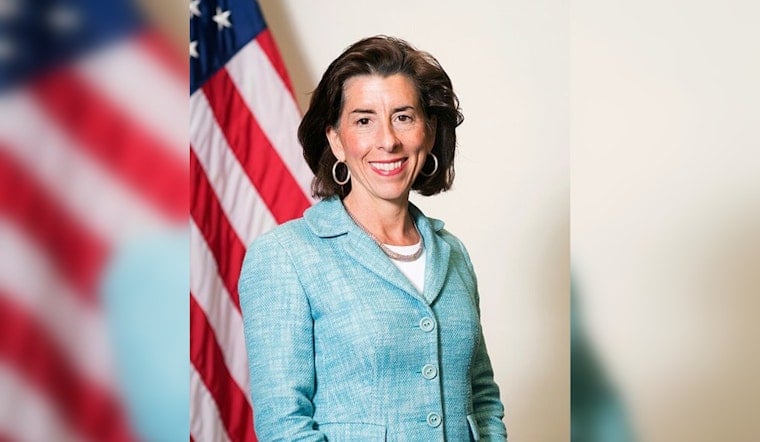
Commerce Secretary Gina Raimondo is not waiting around to see what artificial intelligence does to American paychecks. Alongside Indiana Gov. Eric Holcomb, she has launched a bipartisan effort called RAISE US that is supposed to blunt the labor-market shocks many experts say are already on the way. The group plans to seed state-level pilot programs in Arkansas, Connecticut, Maryland and Utah to retrain workers, expand paid training and test employer-backed career pathways. The mission, backers say, is straightforward: keep people working while the economy quietly rewires itself around new AI tools.
Researchers and policymakers have been scrambling to gauge the size of the problem, and the numbers are not exactly soothing. An April analysis from Boston Consulting Group estimated that roughly half of U.S. jobs will be reshaped and that as many as 25 million roles could vanish over the next five years. Goldman Sachs has warned that a quarter of all U.S. work hours may be automated. In response, RAISE US says it will look at steps like tax and incentive changes as part of its toolkit, according to The Associated Press. The organization is pitching itself as a place to run fast experiments and see what actually helps.
How the pilots will work
RAISE US is building four coordinated pillars: AI-Ready States, education and training, an employer coalition and a policy lab. Together, they are meant to test what really moves workers into more stable, better-paying jobs as roles change. The pilots are expected to try AI-powered career navigation tools, short credential programs and “earn while you learn” models that pay people as they train. States and employers are supposed to agree up front to hire or redeploy participants who make the cut, according to RAISE US. Organizers say the policy lab will track results so that any winning ideas can hop from state to state instead of dying as one-off experiments.
Who’s backing it and why it matters
Big-name companies and philanthropies are already writing checks. Amazon has signed on as a founding member, and early anchor partners include Microsoft, Anthropic, the OpenAI Foundation and Bank of America, along with employers like UPS and General Motors. Axios reports the effort has $500 million committed so far and wants to push that to $1 billion, with plans to test ideas such as wage insurance, new incentive structures and AI-driven career coaching, according to Axios. Backers argue that the mix of private money and state commitments can get programs running far faster than anything that waits on Congress.
Not everyone is convinced that retraining is a silver bullet. “AI is now disrupting multiple sectors simultaneously, faster than any institution can respond,” neuroscientist Vivienne Ming warned. Analysts point out that past retraining pushes have delivered mixed results when they lacked firm hiring commitments or wage supports. The question of whether private cash and scattered state pilots can grow into a real safety net is turning into a live policy fight, according to The Associated Press.
Maryland will be one test case
Maryland is about to find out what all of this looks like on the ground. One early pilot there is being built as a kind of domestic service and work-experience program that would pay young people while they build skills local employers say they need, a model Raimondo and Maryland officials hope can eventually be exported to other states, according to The Washington Post. Gov. Wes Moore has welcomed the partnership and, on the RAISE US site, has emphasized both paid work and measurable job outcomes. State officials say early, visible wins will be critical if they want companies to retrain workers instead of reaching straight for the layoff button.
RAISE US leaders say they want hard evidence of what works, not just glossy pilot announcements, and they talk about handing states and employers a repeatable playbook. The organization describes a policy lab and employer pilots that are tightly focused on outcomes, and Raimondo has signaled she plans to work across party lines even as she stops short of aggressively backing sweeping federal tax changes herself, according to Semafor. Whether this mix of private money, employer promises and state-level experiments can really soften the social shock of rapid AI adoption is the trial RAISE US is about to face.





