

























































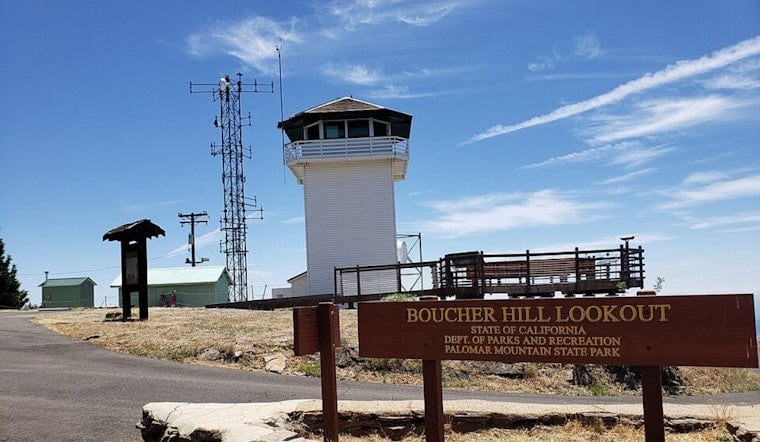
San Diego County’s historic fire-watch towers are expected to sit empty at the start of the 2026 wildfire season, volunteers warn, leaving long stretches of backcountry without the human spotters that have flagged distant smoke for generations. The shutdowns arrive as agencies and volunteers scramble for cash, materials and contractors to fix aging steel and concrete perched on remote ridgelines.
Two key towers, High Point on Palomar Mountain in the north and Los Pinos in the south, will not be staffed during this fire season, volunteers said, after inspections turned up structural issues and repair costs that volunteers estimate are well into six figures. Leif Blensly, local chapter chair of the Forest Fire Lookout Association, told FOX5 San Diego the closures leave large areas without a key layer of wildfire detection. Another longtime volunteer, Bob Littlejohn, told the station that when the towers are staffed, their smoke reports are typically relayed to the U.S. Forest Service office that is colocated with Cal Fire in El Cajon.
The towers are part of a volunteer lookout network that has kept High Point and Boucher Hill active in recent years. The San Diego-Riverside chapter of the Forest Fire Lookout Association schedules shifts and helps maintain the historic structures when they are open, according to the Forest Fire Lookout Association. The group notes that lookouts have returned to Palomar after volunteer-led restorations, although the ability to staff and preserve the towers still depends heavily on agency repairs and outside funding.
How Lookouts Fit With Modern Detection
High-altitude cameras and HPWREN sensor networks have expanded across the region in recent years, giving dispatchers more real-time views of wind, smoke and developing incidents. Technicians and volunteers say those systems are a powerful tool, but one that is meant to work alongside, not instead of, trained observers in the towers. HPWREN has documented how mountaintop cameras, archived imagery and emerging AI tools are used to bolster situational awareness during fires, while volunteers argue that experienced lookouts still catch subtle cues that automated systems can miss.
Funding And What’s Next
Volunteers say the future of the towers now hinges on whether the U.S. Forest Service can move the needed repairs high enough on its priority list and free up money to make the structures safe to staff again. The local chapter’s reports and historical notes describe past restoration work and ongoing volunteer training, yet they also spell out that many of the biggest needs, from replacement cabin glass to significant concrete repairs, will require federal funding and outside contractors, according to the Forest Fire Lookout Association.
That matters in a county where fire season often feels almost year-round, typically stretching from spring into fall, and where early detection can shave hours or even days off response times. State statistics and preparedness materials from CAL FIRE highlight how heavily the region leans on fast detection and aggressive suppression once the weather heats up.
For residents, officials and volunteers say the basics still rule the day, with or without staffed towers: maintain defensible space around homes, follow burn restrictions and call local dispatch immediately to report smoke or suspicious activity. “These towers are one layer of many,” a volunteer told FOX5 San Diego, “but losing them makes everything else harder.”





