

























































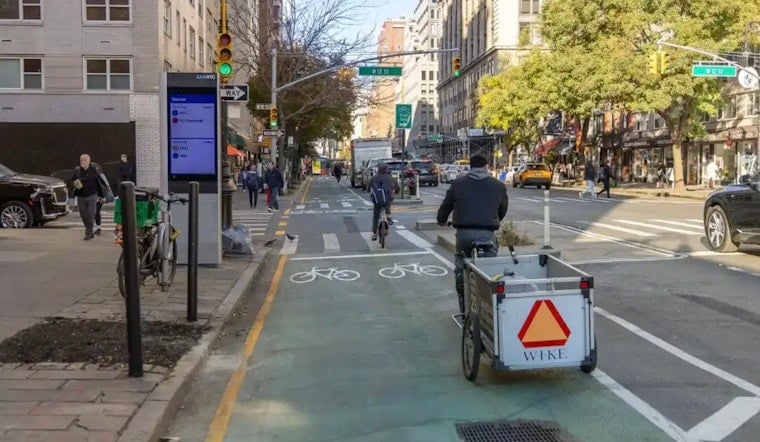
Sixth Avenue could be in for a major makeover, as the city’s Department of Transportation has floated a plan to turn roughly 63 blocks of the corridor into a bus-priority route, with quicker buses, wider bike lanes and new pedestrian islands on deck. The draft blueprint, shown to a Manhattan community board this week, would rework curbside loading and bus stops across a long stretch of Midtown. City officials say the redesign is meant to speed up local and express buses that are currently crawling in heavy traffic.
According to a presentation reported by amNewYork, DOT is looking at converting an existing curbside bus lane between West 35th and West 56th Streets into an offset lane, and on some blocks installing both an offset and a curbside lane so buses can use block-long stops. The plan also calls for extending a double-width protected bike lane in the Midtown section and adding concrete pedestrian islands, curb extensions and turn-calming treatments. NYC DOT Commissioner Mike Flynn said the proposal is intended to deliver “faster and safer commutes for bus and bike riders commuting in Manhattan from all five boroughs,” as quoted in the report.
What DOT Would Change
DOT materials outline a toolkit of changes: offset bus lanes that move coaches away from curbside loading conflicts, double bus lanes where extra capacity is needed, pedestrian refuge islands and longer boarding islands to speed up bus loading and unloading. The agency also proposes widening protected bike lanes to better fit faster e-bikes and allow side-by-side riding in the busiest sections. Officials note that these types of elements match other busway and bus-priority projects the city has rolled out, which are described on NYC DOT.
Why The City Says It’s Needed
At the community board briefing, DOT cited bus speeds that are slow even by Midtown standards, saying local routes on the corridor can move at about 3.5 miles per hour, with evening-peak express buses averaging roughly 4.2 miles per hour. Those figures were highlighted in the agency’s presentation and reported by amNewYork. The redesign is pitched as a quality-of-life boost for an estimated 51,000 MTA bus riders who use routes along Sixth Avenue. The push lines up with Mayor Zohran Mamdani’s pledge to increase bus speeds by up to 20 percent on 45 priority corridors, a goal he laid out in his Mayor's Office 100-day address.
Who Would Be Affected
City officials say the corridor carries riders commuting from all five boroughs, from long-distance express passengers to local riders heading to Midtown jobs and transfer points. The proposed double-wide protected bike lane is meant to handle faster e-bikes and allow side-by-side cycling in crowded stretches, while curbside loading and parking would be rearranged to put bus movement first. DOT typically brings these sorts of permanent street changes to community boards before moving ahead, as part of a project process described by NYC DOT.
Next Steps
DOT says it will now bring the plan to other affected community boards, gather feedback and refine the design before setting any implementation timeline. The city has moved relatively quickly on similar Midtown projects this spring, most recently advancing a 34th Street busway announced by the mayor in early June, and officials say Sixth Avenue could follow a phased, neighborhood-by-neighborhood rollout, according to the mayor’s office. Details such as enforcement, hours of operation and whether to rely on physical barriers or curb cameras to keep bus lanes clear are expected to be sorted out during the community-review phase.
Riders and businesses along the avenue are being told to expect public meetings and design tweaks over the summer, with DOT officials inviting local input at the community board session where the plan first appeared. If the proposal wins approval and is built, city officials say it could shave minutes off many Midtown bus trips while adding more protected space for cyclists and safer crossings for pedestrians.


