

























































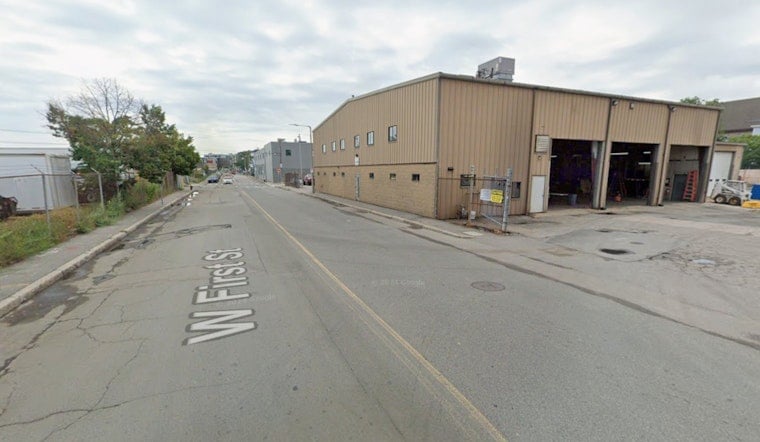
Jackhammers are finally rattling the long-quiet lot at 295 West First Street in South Boston, where Jones Street Investment Partners has started turning a long-idle crane yard into a six-story, 236-unit apartment complex with a publicly accessible park and ground-floor community space. The project, now moving from planning into active construction, will deliver a mix of market-rate apartments and income-restricted homes and is expected to be finished in roughly a year. That timeline follows a review process where residents and city planners sparred over the look, feel and scale of the building, while the developer promised new street trees, bike facilities and about 125 structured parking spaces.
Site and groundbreaking
According to Boston Business Journal, Jones Street has started work at the former Shaughnessy crane yard at 295 W First St. The outlet frames the project as part of a broader shift in South Boston from industrial to residential uses along this stretch of the neighborhood.
What the building will include
The development is set to deliver 236 rental apartments across six stories, 36 of them income-restricted, along with ground-floor community, cultural and retail space and a publicly accessible park, according to H+O Structural Engineering. The design covers roughly 226,000 square feet and includes structured parking for about 125 vehicles, plus both resident and visitor bicycle storage. Project documents from the team note a schedule that targets completion in the second quarter of 2027.
Permits, approvals and timeline
The Boston Planning & Development Agency project page for 295 West First Street lists a gross floor area of about 224,567 square feet and shows the status as "Under Construction," with a June 19, 2026 timestamp. Records and reporting indicate the proposal went through Article 80 review and ultimately won BPDA board approval after neighborhood pushback and required zoning variances, a process that Banker & Tradesman describes as involving a "spirited debate" among board members.
Design and sustainability
The project achieved Phius design certification on June 9, 2026 and is listed as an all-electric Phius CORE 2021 design with modeled energy performance and on-site photovoltaic generation, according to Phius. Project materials cite systems such as air-source heat pumps and centralized ERV ventilation, and the team notes rooftop solar and EV-charging infrastructure as part of the overall sustainability package.
Neighborhood impact and public space
Supporters have pitched the parcel as one of South Boston’s last transit-connected infill sites, within walking distance of the Broadway Red Line station and a short walk to the Boston Convention and Exhibition Center. Local reporting also highlights plans for roughly 6,000 square feet of publicly accessible open space and a dedicated bicycle room with one space per unit, plus additional visitor bicycle capacity, according to Boston Agent Magazine. While some neighbors raised concerns about scale and traffic during review, city planners said the design should better stitch the block into the surrounding street network.
What to watch next
Work on the lot is expected to convert the fenced crane yard into an active residential streetscape over the next year, with filings and design certification pointing toward occupancy in 2027, according to Phius. Residents can expect periodic construction impacts at street level as crews remove remnants of the old yard and raise the six-story structure, while the BPDA and the developer plan to post updates to official project records as construction advances.




