

























































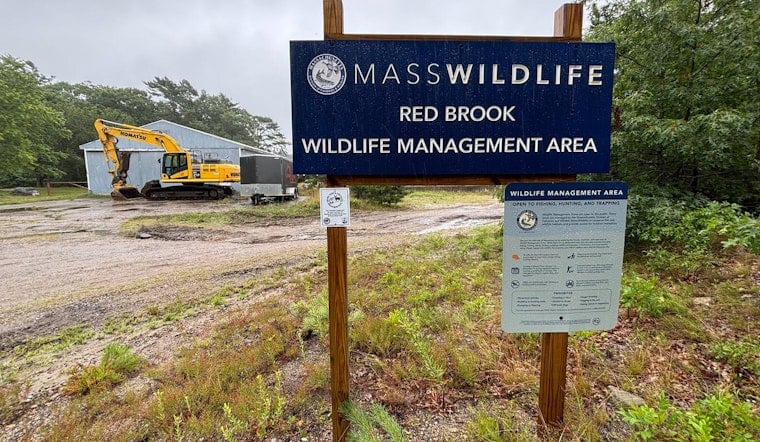
Heavy equipment is now tearing into a 70-acre stretch of retired cranberry farmland straddling Plymouth and Wareham, kicking off construction on a project meant to undo more than a century of agricultural engineering along Red Brook. The site, known as Century Bog, was cultivated for cranberries until 2015, and its transformation marks what officials call the final major step in a decades-long effort to restore the entire Red Brook watershed.
The Massachusetts Division of Fisheries and Wildlife, known as MassWildlife, now owns the Century Bog property, which was previously owned by A.D. Makepeace, according to MassLive. The agency officially launched physical construction on the project in August, targeting the land to reconnect Red Brook with its floodplain and groundwater, according to the Massachusetts government. Red Brook itself is a 4.5-mile spring-fed cold-water stream that forms the municipal boundary between the two towns, and it serves as one of the southernmost habitats for sea-run, or salter, brook trout in North America, according to ecoRI News.
For more than a hundred years, cranberry farming altered this landscape, controlling water flow, straightening streams, and draining natural wetlands, per the same MassLive report. The Century Bog restoration will restore 12,300 feet of Red Brook, reshape parts of the former bogs, and remove culverts, berms and drainage ditches as it converts the farm into a native network of streams and wetlands, the outlet notes.
Undoing a Century of Sand, Dams, and Straightened Streams
The physical challenge beneath the surface is significant. A 2011 environmental feasibility study by Princeton Hydro found that decades of commercial cranberry production left historic pesticide residues, specifically DDT and dieldrin, concentrated within an artificial sand layer applied over the bog's natural peat surface. Commercial growers spread that sand over bogs every few years to boost crop production and suppress weeds, compacting the sand into caps that now must be managed as restoration crews work to uncompact the soil beneath.
State restoration plans call for improving nearly 7,000 feet of stream channel by filling agricultural drainage ditches, removing metal flumes, and planting stream-bank vegetation to lower water temperatures, according to the state's project page. Boulders and woody material will be added to improve stream health and fish passage, per the MassLive report, while the restored stream is designed to connect with existing springs. Cooler water is considered essential for cold-water migratory species such as sea-run brook trout, river herring, and American eels.
“The Century Bog project is a major milestone for restoring wetlands in southeastern Massachusetts,” Alex Hackman said, per MassLive's reporting. Warren Winders said restoring Century Bog to a complex marsh headwater of Red Brook once seemed unattainable. Tom O'Shea said Massachusetts is investing in restoration to sustain biodiversity and help migratory fish reach freshwater to spawn.
A Two-Decade Push Involving Trout Unlimited and Mass Audubon
MassWildlife and its partners have worked on the Red Brook restoration effort for over two decades, according to MassLive. The Southeastern Massachusetts Chapter of Trout Unlimited became involved in the late 1980s and has worked for decades to protect and restore Red Brook, while dam removals and the state's purchase of Century Bog made possible the long-term restoration vision now underway. Mass Audubon and other environmental partners helped fund the effort, and a $4.9 million America the Beautiful Challenge grant was awarded in 2022 to support the work.
Century Bog sits within the 683-acre Red Brook Wildlife Management Area, which state conservation assessments designate as BioMap2 Core Habitat and Critical Natural Landscape, supporting rare habitats like pitch pine-scrub oak forest and coastal plain ponds, according to Mass Audubon. The restoration is part of MassWildlife's Southeastern Massachusetts Pine Barrens Landscape Restoration and Community Engagement Initiative, which aims to protect the largest remaining block of Atlantic coastal pine barrens north of New Jersey. That pine barrens landscape supports species including the frosted elfin butterfly and prairie warbler, per MassLive.
What the Finished Wetland Will Look Like
Once complete, the project will restore approximately 72 acres of wetlands and establish about 47 acres of native upland habitat, including sandplain grassland and pitch pine-oak woodlands, according to MassLive's reporting. State officials say the work will benefit at least 56 species identified as having the greatest conservation need, while also improving biodiversity and local water quality.
Century Bog is not an isolated effort. A primary precedent sits nearby in Plymouth, where the 600-acre former Tidmarsh Farms cranberry operation, retired in 2010, was transformed into a 225-acre wetland sanctuary with three miles of new meandering stream channels, a project Mass Audubon later acquired to establish the Tidmarsh Wildlife Sanctuary. The broader Buzzards Bay watershed has several concurrent bog and stream projects as well, including a $250,000 grant-funded design to convert the 15-acre Puritan Bog in Bourne into a salt marsh and dam removals along 3.2 miles of the upper Agawam River, according to the Buzzards Bay Coalition.
Why So Many Bogs Are Being Retired
Massachusetts held roughly 13,000 acres of cranberry bogs as of late 2025, making it the nation's second-largest producer, even as state programs had already restored more than 500 retired bog acres to wetlands with a goal of 1,000 restored acres by 2035, according to The Cool Down. Massachusetts cranberry bogs generate more than $1.7 billion in annual economic impact, but the industry faces real transition pressure: roughly half of the state's cranberry farms still rely on older, native cultivars like Early Black and Howes, putting them at a competitive disadvantage against Midwestern regions like Wisconsin, where higher-yielding hybrids dominate, according to a study published on ResearchGate.
That economic backdrop helped push the state's 2016 Cranberry Revitalization Task Force to recommend ecological restoration as a preferred outcome for farms where commercial revitalization was not viable. The Division of Ecological Restoration subsequently created a dedicated Cranberry Bog Restoration Program in 2018, which has supported 20 bog restoration projects statewide as of this year, per the Living Observatory's project archive.
Even with construction underway at Century Bog, open questions remain about long-term site management, including how to curb illegal off-road vehicle access and how the surrounding upland pitch pine and sandplain habitats will adapt over time. Those questions will likely take years to answer, much like the restoration effort itself, which required more than two decades of land purchases, dam removals, and coalition-building before the first bulldozer arrived.





