

























































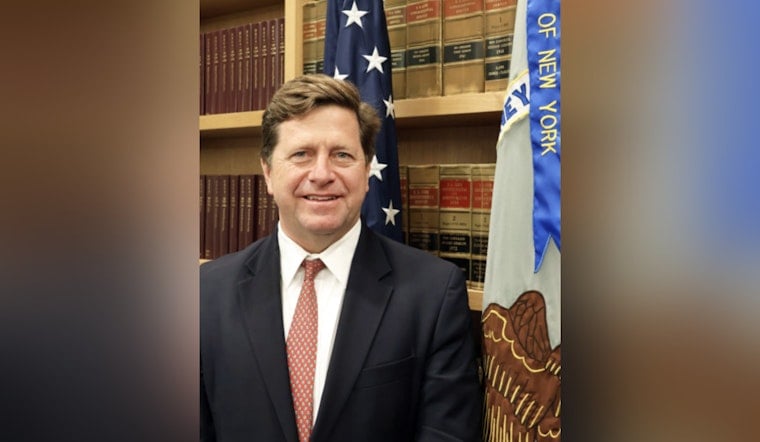
President Trump is reaching into Manhattan’s top federal prosecutor’s office for his next spy boss, announcing Thursday that he will nominate Jay Clayton, the U.S. attorney for the Southern District of New York and a former Securities and Exchange Commission chairman, to serve as director of national intelligence. He urged the Senate to move fast on the pick, as the Office of the Director of National Intelligence continues to reel from Tulsi Gabbard’s departure and the controversial elevation of Bill Pulte as acting director.
Trump rolled out the choice on Truth Social, writing that he was “pleased to announce the Nomination” of Clayton and calling him “very Highly Respected,” according to CBS News. The post also pressed the “United States Senate” to confirm Clayton “as soon as possible,” a not-so-subtle signal that the White House wants to move past the drama surrounding the temporary acting appointment.
Clayton currently oversees prosecutions out of Manhattan as the United States attorney for the Southern District of New York, according to the U.S. Attorney's Office. His office has handled high-profile fraud, cartel and gang cases in the district. Before that, he served as chairman of the Securities and Exchange Commission from 2017 to 2020, per the SEC.
Why Congress Is Watching
On Capitol Hill, Clayton’s name lands in the middle of an already tense fight over surveillance powers. Lawmakers have warned that elevating Pulte to acting DNI, combined with the lack of a clear permanent nominee, has bogged down work on renewing Section 702 of the Foreign Intelligence Surveillance Act, a major overseas surveillance tool set to lapse this weekend, according to AP News. Democrats have said they will withhold support for an extension while Pulte remains slated to take the job, and some Republicans have questioned whether he is qualified for the role at all. By putting forward a Senate-confirmable nominee like Clayton, the White House appears to be trying to clear that political roadblock.
Clayton’s Experience And The Legal Bar
Supporters tout Clayton’s blend of regulatory, corporate and prosecutorial experience as proof he can manage the ODNI’s sprawling bureaucracy. The law sets a higher hurdle than simple management skills, however. Under the Intelligence Reform and Terrorism Prevention Act of 2004, anyone nominated for DNI “shall have extensive national security expertise,” a phrase that is certain to dominate his confirmation hearings, per the U.S. Code. The statute does not spell out exactly which backgrounds qualify, which leaves it to senators to decide whether a Manhattan U.S. attorney with Clayton’s résumé meets the standard. Expect pointed questions about his national security chops and how he plans to handle staffing and oversight.
Next Steps
The White House still has to formally send Clayton’s nomination to the Senate, which would kick off hearings in the Senate Intelligence Committee followed by a floor vote. The timing is crucial, since lawmakers are weighing the FISA renewal this weekend, according to AP News. If Clayton can secure quick bipartisan backing, the stalled Section 702 extension could move ahead. If his nomination bogs down, Congress could be staring at a short lapse in collection authority that intelligence officials warn could undercut counterterrorism work.
For New Yorkers, the move yanks Manhattan’s chief federal prosecutor out of his home turf and drops him into a bare-knuckle national fight over surveillance powers and intelligence oversight. The coming confirmation process, with written questions, public hearings and a final floor vote, will test whether Clayton’s record at the SEC and in Manhattan courtrooms satisfies both the legal requirements and the political reality of the DNI job.





