

























































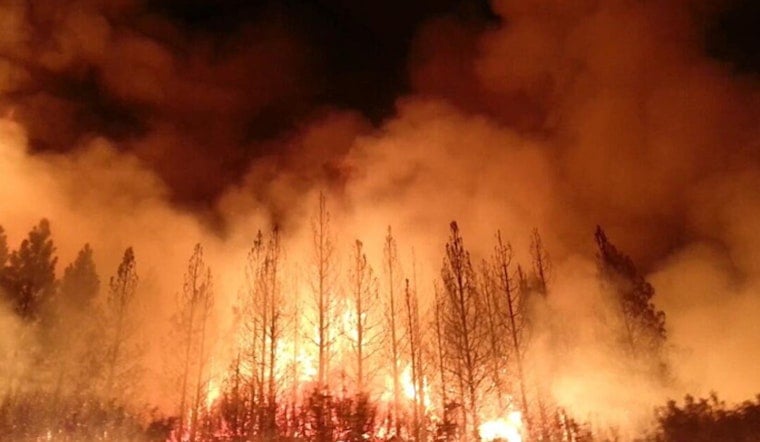
High severity wildfires - the kind that wipe out most trees in their path - are now tearing across far larger chunks of California forest than they did four decades ago, according to a new UCLA analysis released Monday. The paper tracks a sharp rise in stand replacing fires and a steady climb in the total area burned each year, a one two punch that researchers say could permanently reshape forested landscapes and the air, water and local economies that depend on them.
“These high severity, forest replacing fires used to be uncommon, and now it’s the dominant fire type,” said Park Williams, a senior author on the study. Reporting on the paper notes that the study, published in the Proceedings of the National Academy of Sciences, found that the area burned by high severity fires has increased by roughly a factor of 30 between 1985 and 2024, while total forest acreage burned annually has grown by about a factor of 10. The authors also report that high severity fires have outnumbered low severity fires every year since 2012, a clear sign that the state’s fire regime is tilting toward more stand replacing events, as MyNewsLA reported.
Aridity and fuels are reshaping fire severity
The researchers tie the surge in stand replacing burns to increasingly warm and dry conditions that parch vegetation and make extreme fire behavior more likely. That shift shows up in rising vapor pressure deficit during recent fire seasons. By using tens of thousands of satellite derived severity maps, the team shows that hotter, drier years produce a larger share of high severity patches inside fire perimeters, especially where aboveground biomass is high. The technical methods and regional breakdowns are laid out in the UCLA paper, which details how vapor pressure deficit and fuel loads interact to turbocharge stand replacing fires across the state’s forested regions (preprint).
Where the worst changes are happening
The biggest jumps in high severity fire are showing up in densely forested, high biomass areas, including parts of the Sierra Nevada and the wetter stretches of the northern coast. In those places, very large fires are now carving out broad interior cores of tree mortality instead of the finer mosaics of burned and unburned patches that help forests bounce back. Those large, continuous high severity zones push surviving seed sources farther away and increase the odds that forests eventually flip to shrubland or grassland. Compilations of wildfire perimeters and burned area maps, including the WUMI 1984 to 2024 database, and recent U.S. Forest Service work document how very large fires now account for a disproportionate share of high severity area in California’s forests (USFS).
What officials are doing
State agencies and land managers say they are ramping up landscape treatments like targeted thinning and expanded prescribed burning to cut the odds that fires near communities turn into unstoppable, stand replacing events. California has boosted funding, streamlined approvals and accelerated both controlled burns and mechanical treatments this year as part of a wider wildfire resilience effort. For details, state officials point to guidance from CAL FIRE on prescribed fire and to the governor’s five year action plan that outlines how prevention projects and fuel treatments are being scaled up (Governor’s Office).
Why Angelenos should care
Even when the flames stay deep in the mountains, the fallout does not. Smoke from distant fires can blanket cities, hammering air quality and public health, while changes in snowpack and watersheds complicate already tense water management debates. UCLA reporting on climate driven shifts in California’s fire seasons notes that earlier, longer seasons and larger, stand replacing blazes ramp up smoke exposure and strain water and emergency systems. All of that makes forest loss something much closer to a civic problem than a wilderness issue for millions of Californians (UCLA Newsroom).
The study frames these trends as both an ecological alarm and a test of policy. Managers can lower local risk with tools like thinning and prescribed fire, but the authors emphasize that those efforts need to be paired with actions that confront warming and increasing aridity if the underlying odds of stand replacing fire are going to change. For communities, the bottom line is blunt: large, high severity fires are likely to keep coming unless fuel pressures and climate pressures are tackled together, a conclusion the researchers back up with detailed data and modeling in their analysis (preprint).





