

























































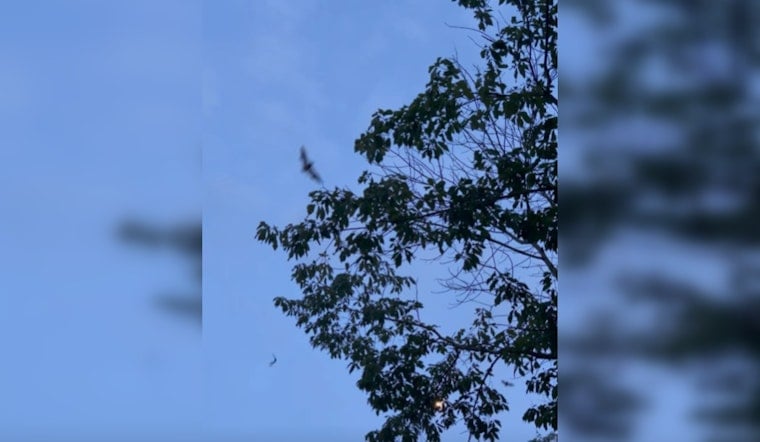
More than 100,000 endangered gray bats poured out of Nickajack Cave at dusk over Nickajack Reservoir, forming a dark ribbon of wings that arced across the river and kept coming for roughly forty-five minutes. The whole scene was captured in video posted by the Tennessee Wildlife Resources Agency on July 10, 2026.
Nickajack Cave is a partially flooded cavern on the Tennessee River whose entrance was fenced off in the early 1980s to protect a gray bat maternity colony. The site was later designated Tennessee’s first non-game wildlife refuge. The gated entrance and a shore-side observation platform let bats come and go while keeping people at a safe distance, according to Tennessee River Valley Geotourism.
Why This Colony Matters
The gray bat (Myotis grisescens) is federally listed as endangered, and federal biologists stress that the species depends on a very small number of caves for winter hibernation. The U.S. Fish and Wildlife Service estimates that roughly 95% of the range-wide population hibernates in as few as 15 caves, which makes each protected maternity roost, including Nickajack, disproportionately important to the species’ recovery. Those concentration risks mean disturbances or habitat loss at key sites can ripple through the entire population, according to the U.S. Fish and Wildlife Service.
A Nightly Spectacle and an Ecological Service
Long-time observers and bat researchers report that the Nickajack maternity colony can number well above 100,000 individuals, with field accounts describing emergences where bats stream from the cave mouth in a steady column for roughly 30 to 45 minutes. The flights are more than a local oddity. Guides and naturalists note that the colony eats vast quantities of insects each summer, a pest-control service estimated in some guides at hundreds of thousands of pounds of insects per year.
Eyewitness reporting and conservation accounts underline both the spectacle and the ecological role of the roost, as described by Merlin Tuttle's Bat Conservation. Local tourism materials echo the same themes, including Sherpa Guides.
Threats and Protections
Despite strong protections, the colony faces ongoing dangers. Human disturbance of maternity and hibernation caves can cause mass abandonment or pup mortality, and white-nose syndrome, a fungal disease that has killed millions of bats, remains a central concern for resource managers, according to the National Park Service.
Federal recovery records point to coordinated actions at Nickajack and other priority sites, including gating, monitoring and habitat maintenance, as part of efforts to protect these colonies, per the U.S. Fish and Wildlife Service.
How to Watch Safely
People who want to see the emergence are urged to use the Maple View observation platform or watch from boats, and to follow posted rules that call for keeping noise, lights and other disturbance to a minimum. Local outfitters offer guided paddles that emphasize safe distance and etiquette, according to Southeast Tennessee.
The Tennessee Wildlife Resources Agency's video of the July 10 emergence was posted to Facebook and captures the scale of the colony, as shown on Facebook. State and federal partners continue to manage the refuge to keep the bats protected while allowing responsible viewing, according to Southeast Tennessee.





