

























































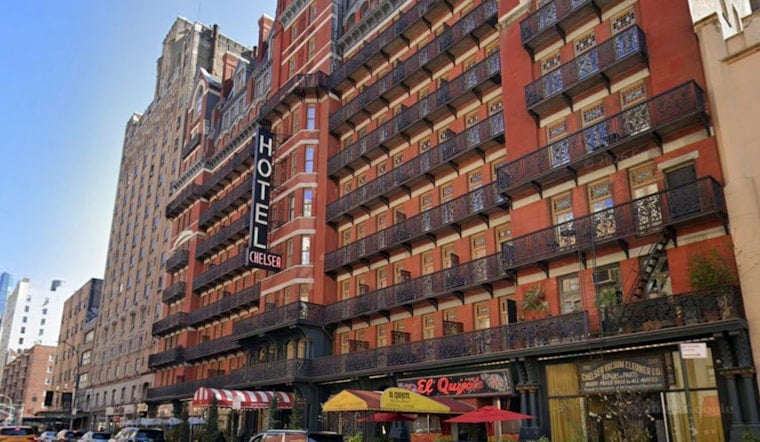
Longtime Chelsea Hotel resident and artist Gerald DeCock says the building’s owners are trying to kick him out of the very rooms his paintings help decorate. DeCock, 67, who has lived at the Hotel Chelsea since 1994, says he is not interested in a buyout and intends to stay put in his studio. The clash has turned into yet another high-profile skirmish in the decades-long fight over what the storied landmark is, and who still gets to call it home.
As reported by the New York Post, owners Richard Born, Ira Drukier and Sean MacPherson have moved to evict DeCock, and at one point offered to move him to another unit for $10,000 a month. According to the Post, that offer was later pulled after DeCock launched a social-media campaign about his situation. He told the paper he feels disrespected by management and “does not want a buyout,” and the outlet reports he is due back in court next month. The Post also notes that an LLC tied to the hotel bought 21 of his paintings while the dispute was unfolding.
Court records show DeCock moved into apartment 1014 on Oct. 1, 1994, at a rent of $2,000 a month, which later rose to roughly $2,700, according to a March 2023 order from the New York State Supreme Court. That decision recounts how the Division of Housing and Community Renewal reviewed the unit’s rental history and concluded it was not covered by the Rent Stabilization Law because of the timing and amount of the 1994 vacancy rent.
An Appellate Division opinion later upheld DHCR’s determination, which left DeCock with limited legal options in state court and narrowed the path for arguing that his unit should be rent stabilized. Legal databases and court filings show he has repeatedly challenged the agency’s finding and has lost on appeal. FindLaw carries the appellate ruling and related docket details.
A New York advocacy group that has tracked the case says public pressure changed the stakes. Dreamtone NYC says its short documentary episodes and social media posts helped bring in buyers for DeCock’s work, raised money for new legal representation, and spurred what it describes as tangible legal and financial shifts for the artist.
The battle mirrors long-running tensions at the Hotel Chelsea as ownership pushes to reposition the property while longtime residents resist being swept aside. National outlets have documented how renovations, art deals and lawsuits have repeatedly pitted artists against developers at the address that once billed itself as an urban bohemia; for a broader look, see coverage from CBS News.
Legal context
Under New York’s rental rules, apartments that were vacant in the mid-1990s and rented above certain thresholds could be treated as deregulated. That technical status decides whether a tenant receives rent-stabilization protections. State officials applied those vacancy-decontrol and registration rules when courts sided with DHCR’s reading of the law in DeCock’s case. NY State Homes and Community Renewal provides guidance on how those regulations work.
DeCock says he intends to keep fighting both in court and online, and advocates argue the dispute raises bigger questions about what kind of place the Chelsea will be for artists going forward. His next court date is scheduled for next month.



