

























































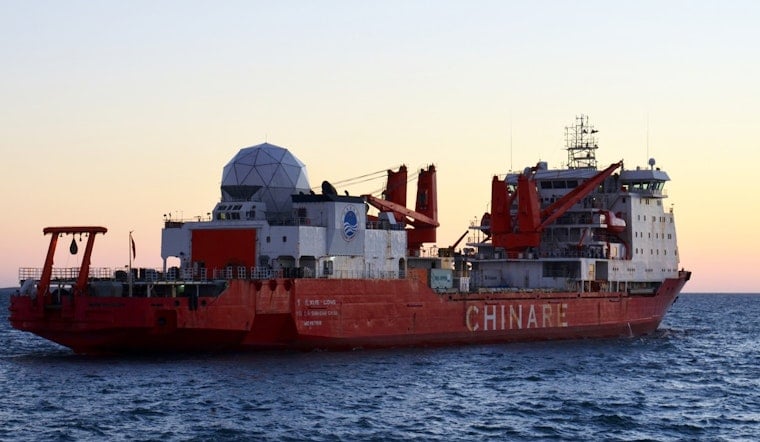
Last Sunday the U.S. Coast Guard had unusual company in the Bering Sea, trailing two China-flagged research icebreakers, the Xue Long and Xue Long 2, as they headed north toward the Arctic. The ships transited through the U.S. exclusive economic zone and over portions of the extended continental shelf, and the Coast Guard shadowed them with the cutter Munro under Operation Frontier Sentinel to track their course and be ready to respond if the vessels attempted any unauthorized activity. It was the first time this year the service had monitored Chinese research vessels through those specific U.S. maritime zones.
According to a July 17 press release from the U.S. Coast Guard, the Xue Long crossed the U.S. EEZ and over the extended continental shelf while the Xue Long 2 was also observed heading toward the Arctic. The release states that the Munro executed Operation Frontier Sentinel "to protect American sovereign rights, ensure consistency with international law, and position the Coast Guard to rapidly respond to any detected malign activity." The service added that its Arctic District has seen heightened activity and expects maritime traffic in the region to continue increasing through the summer.
Rear Adm. Bob Little, commander of the U.S. Coast Guard Arctic District, used the release to underscore how many players are now involved in watching the High North. "Alongside the Department of War, the Department of State, and our international partners, we are actively responding to competitor activities across an increasingly contested Arctic," he said. He noted that monitoring transits helps verify whether vessels are engaged in permitted research or other allowed operations. The Coast Guard also reminded mariners that active marine scientific research in the U.S. EEZ or on the extended continental shelf requires advance U.S. permission and the sharing of any data collected.
What the law requires
International law still gives foreign ships considerable latitude to move through another country's EEZ, but it draws a sharper line when it comes to research. Part XIII of the U.N. Convention on the Law of the Sea, adopted under the auspices of the United Nations, sets out a consent regime for marine scientific research in a coastal state's EEZ and on its continental shelf. In practice that allows coastal states to require foreign researchers to seek permission, accept conditions, and provide data from their expeditions. Experts say that framework shapes how the Coast Guard, the Defense Department, and U.S. diplomats assess foreign activity near U.S. maritime zones.
Bigger picture
The latest monitoring comes against a backdrop of increased Chinese polar operations over the past two years, including a summer 2025 deployment when multiple Chinese research ships operated near Alaska and drew Coast Guard responses. Reporting by USNI News detailed how U.S. cutters and aircraft moved in to track those vessels, a pattern analysts say reflects Beijing's growing investment in icebreaking and polar science platforms.
What to watch
Coast Guard officials say they plan to keep following vessel movements with cutters and aircraft while coordinating with the Defense Department, State Department, and international partners. For more on the service's notice, see the Tampa Free Press report.



.JPG)