

























































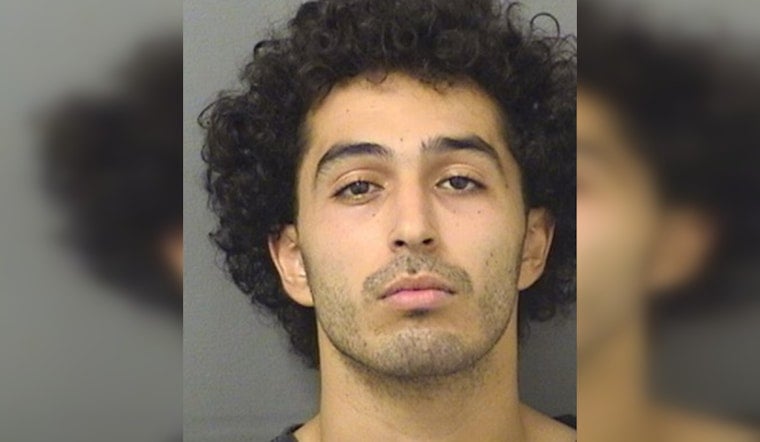
Police say a Miami man expecting to meet a 14-year-old at a Delray Beach Dollar Tree instead met handcuffs.
Delray Beach police arrested Kevin Alvarez on Wednesday after he allegedly traveled to the discount store for what he thought would be a meetup with a teenager, according to an arrest report. Officers detained him as the planned meeting time approached and took him into custody on felony allegations. Authorities say he is accused of traveling to meet a minor for an unlawful sex act and using a two-way communications device to facilitate a felony.
According to a probable-cause affidavit and reporting by CBS12, Alvarez exchanged messages with someone he believed was a 14-year-old and arranged to meet near 1230 W. Linton Blvd., by the Dollar Tree in Delray Beach. The affidavit states police read Alvarez his Miranda rights and took statements at the scene after volunteers connected to the online group 561 Predator Catchers notified investigators. CBS12 reports Alvarez was arrested shortly after arriving at the planned location. The charges remain allegations and the case is still pending.
How the Delray stings work
Delray Beach has become a regular backdrop for civilian decoy operations run by 561 Predator Catchers, a group that creates online profiles posing as minors and then enlists volunteers to confront suspects in public. As a similar Grindr sting case and other coverage have laid out, the pattern usually follows the same script: online chat messages, an agreed public meetup spot and a call to police once the alleged suspect shows up.
Supporters argue the group helps expose would-be predators. Critics and some lawyers counter that its tactics can complicate how evidence is collected, handled and presented once a case moves into a courtroom.
Why prosecutors and defense attorneys worry
Reporting by The Palm Beach Post has raised red flags about civilian sting operations that blur the line between citizen activism and formal police work. Evidence gathered by non-law-enforcement actors can trigger disclosure fights and chain-of-custody questions once it lands in court.
Local defense attorneys have already pressed those points in other cases tied to 561 Predator Catchers, saying video uploads and loose preservation practices can create headaches for prosecutors and judges trying to keep trials on solid legal footing. Prosecutors say they review each referral, but the ongoing debate has brought extra scrutiny to how police rely on and process tips from civilian groups.
Legal charges and penalties
Under Florida law, traveling to meet a minor after electronic communications is criminalized in Fla. Stat. 847.0135, while unlawful use of a two-way communications device is addressed in Fla. Stat. 934.215. Both offenses are charged as felonies. Traveling to meet a minor is typically a second-degree felony, and unlawful use of a two-way device is generally a third-degree felony.
Under the state's penalty structure, a second-degree felony can carry up to 15 years in prison, and a third-degree felony can carry up to five years. The sentencing ranges are outlined in the Florida penalty chart published by FindLaw.
What comes next
For now, Alvarez's arrest report is part of an early-stage investigation. If the State Attorney's Office moves forward and files formal charges, the case will proceed in Palm Beach County court, starting with arraignment and pretrial hearings.
As The Palm Beach Post and other reporters have noted, earlier prosecutions tied to civilian sting groups have sparked discovery disputes and legal challenges that can drag out timelines. Any charging decisions and upcoming hearings in Alvarez's case will appear on the Palm Beach County court docket.





