

























































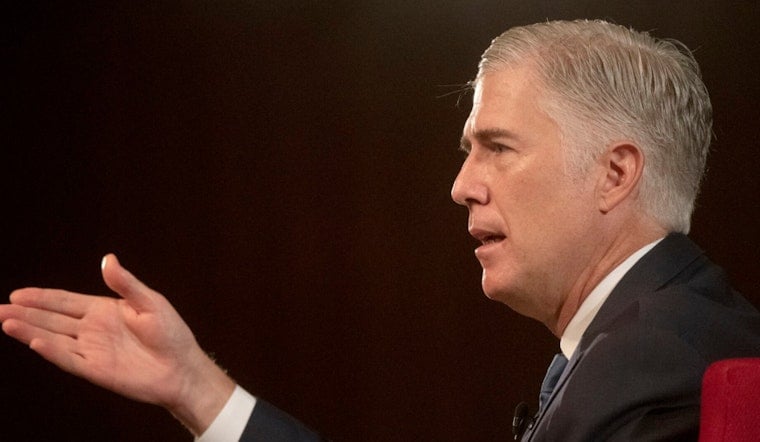
Supreme Court Justice Neil Gorsuch is drawing a sharp line between patriotism and Christian nationalism, bluntly rejecting the idea that the United States was founded as a Christian nation and calling that claim “demonstrably false.” In a recent public interview, he rooted his argument in the country’s early history, saying the colonies were established with religious pluralism in mind, not allegiance to a single faith.
Gorsuch laid out his case in a wide-ranging conversation last Friday on the PBS program “Firing Line.” Speaking about the country’s origins and civic culture, he said the colonies were settled “for religious pluralism” and that America “was never supposed to be a nation that was about one race or one religion,” according to PBS. His description of the Christian nation narrative as “demonstrably false” stands out as one of the clearest rebukes of that idea from a conservative justice sitting on the current Court.
His comments arrive as some administration officials and conservative activists publicly frame American identity in explicitly Christian terms. Vice President J.D. Vance told a Turning Point USA crowd in December that “Christianity is America’s creed,” a formulation critics say overlaps with Christian nationalist ideology, as reported by the Associated Press.
The interview clip quickly bounced from social media to newsrooms. On Tuesday, Fox San Antonio highlighted how Gorsuch’s remarks cut directly against messaging from prominent administration figures and have renewed arguments over church-state separation.
Why it matters
Having a sitting justice openly dismiss a strain of conservative political theology is not just courtroom trivia. It drops a high-profile judicial voice into a running culture-war fight over what, exactly, the Constitution says about national identity. Legal analysts note that the Court’s recent term has significantly shifted the relationship between government and religion, and that public statements from the justices can influence how lawyers, lawmakers and advocates frame those disputes, according to SCOTUSblog.
What comes next
Advocacy organizations and church-state watchdogs say Gorsuch’s words will likely be quoted by both supporters and opponents of the administration as it continues to back policies wrapped in religious language. The Baptist Joint Committee for Religious Liberty has warned that any move to blur the line between church and state can carry serious legal and civic fallout, and has signaled it will be closely tracking how the Court and the executive branch respond, according to BJC.
Gorsuch’s comments do not change any doctrine on their own, but they add an unexpected and prominently placed counterweight to Christian nationalist claims circulating within parts of the conservative legal world. For now, his short exchange is poised to echo through legal briefs, pundit panels and the season’s political fights.





