

























































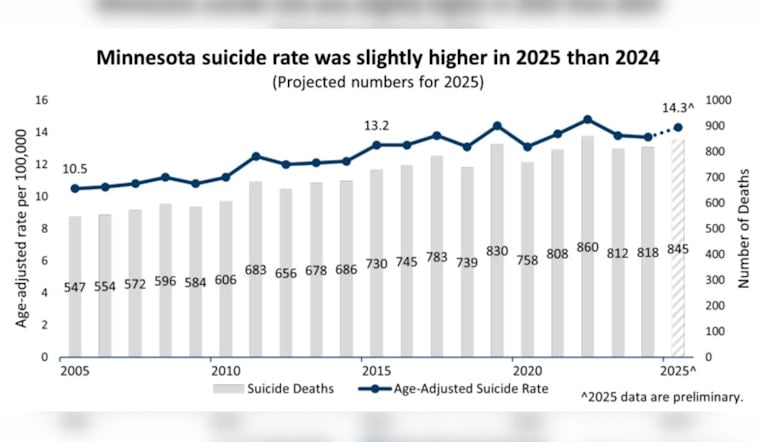
Minnesota’s suicide numbers nudged in the wrong direction in 2025, as a spike in deaths involving firearms wiped out some of the fragile progress seen among younger adults. The provisional figures have advocates and public health officials again pressing for more prevention funding, safer gun storage, and stronger crisis services across the state.
State Numbers: What the Data Show
Preliminary figures released by the Minnesota Department of Health put the state’s age-adjusted suicide rate at about 14.3 deaths per 100,000 people in 2025, with an estimated 845 Minnesotans dying by suicide. That is roughly a 4% increase from 2024, according to the Minnesota Department of Health. The department’s brief, published May 26, 2026, notes that 2025 totals are still preliminary and could change as death certificates are finalized.
Firearms Fueled Much of the Increase
Firearms were the leading mechanism of suicide in 2025 and now account for roughly half of suicide deaths statewide, a sharp jump from earlier years. Local reporting indicates that firearms made up about 51% of Minnesota suicides in 2025, and Minnesota Reformer reports roughly 424 firearm suicides, part of a wider tally of 549 gun deaths in the state last year.
Who’s Being Hit Hardest
The increase was not spread evenly across the population. Men continued to die by suicide at far higher rates than women, with the male rate rising from 21.2 to 23.0 deaths per 100,000 people, while the female rate fell to about 5.8 per 100,000. The state brief also flags a troubling rise among young teens, noting that the suicide rate for children ages 10 to 14 more than doubled in 2025 compared with the previous five years. Indigenous Minnesotans had the highest crude suicide rate among racial groups, and rural counties again recorded higher suicide rates than urban areas, a pattern the Minnesota Department of Health says has persisted for decades.
988 Lifeline Tied to Declines for Some Younger People
There is at least one hopeful signal in the data. A research letter in JAMA found that launch of the 988 Suicide & Crisis Lifeline was associated with an approximately 11% decline in suicide deaths among people ages 15 to 34 nationally, and state health officials say Minnesota’s provisional declines among older teens and young adults line up with that finding. The analysis used national death certificate records to model expected trends and then compare them with observed mortality after the rollout of 988.
What Advocates and Officials Are Urging
Advocates and public health groups are now pushing for prevention efforts that more directly address firearm access, rural mental health gaps, and community support after a death by suicide. Protect Minnesota has described 2025 as part of a “suicide crisis” and is urging lawmakers to expand safe-storage programs, increase funding for local prevention grants, and strengthen crisis-response capacity, framing those steps as both short- and long-term strategies, according to Protect Minnesota.
If you or someone you know is in crisis, call or text 988 or visit 988Lifeline.org to chat with a counselor. For the data referenced in this report, see the Minnesota Department of Health’s provisional brief and local coverage of the numbers.




