

























































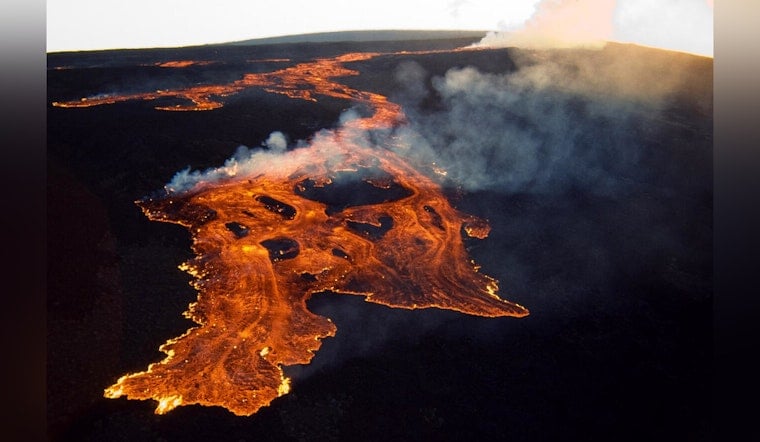
The volcanic engine under Hawaiʻi is not quietly fading out with age. A sweeping new study led by University of Hawaiʻi at Mānoa researchers reports that the mantle plume feeding the islands has actually warmed by roughly 250°C over the past 47 million years, upending the textbook idea that hotspots cool as they drift. The work links deep-mantle temperature to the sheer size of Hawaiian volcanoes and flags two major heat surges that helped build some of the chain’s biggest shield volcanoes.
Taking Hawaiʻi’s mantle temperature
To get at temperatures tens of millions of years in the past, the team turned to chemistry and seafloor mapping. They used a new olivine-based geothermometer on volcanic rocks, then paired those mantle-temperature estimates with modern bathymetric volume measurements of the volcanoes themselves. The peer-reviewed study in Earth and Planetary Science Letters reports an overall increase in mantle potential temperature of about 250°C since 47 million years ago and identifies two distinct heating spikes, one around 14 to 20 million years ago and a younger one between 0 and 6 million years ago.
UH lead on the volcano-size shocker
Project lead Michael O. Garcia, an emeritus professor in the School of Ocean and Earth Science and Technology, did not expect the numbers to line up quite so cleanly. He called the strong correlation between inferred mantle temperatures and volcano size “a major surprise.” According to the University of Hawaiʻi at Mānoa, the researchers analyzed olivine basalts from 16 volcanoes scattered along the Hawaiian Ridge, a chain that includes about 65 volcanic edifices stretching roughly 3,500 kilometers across the Pacific.
What it really means for Hawaiʻi’s volcano hazards
All of this might sound like the prelude to a disaster movie, but the authors are clear that their findings are a record of deep-mantle behavior over millions of years, not a forecast for next week’s eruption update. The results do not point to any immediate shift in eruption risk at summit vents such as Kīlauea or Mauna Loa. As reported by Phys.org, the paper instead suggests that the plume’s warming likely reflects drifting thermochemical domains in the lowermost mantle that alter how much heat is delivered to the hotspot on geologic time scales.
How much hotter, how much lava and why it matters
The researchers did not stop at saying the plume is hotter; they put numbers on what that means for volcanic output. The study finds a strong sensitivity between mantle potential temperature and erupted volume, on the order of 289 ± 78 cubic kilometers of extra volcanic material for every 1°C of temperature increase. According to the authors, that relationship helps explain why only the hottest segments of the plume were able to build the very largest shield volcanoes. The paper concludes that the two identified heat surges likely generated Pūhāhonu and the Hawaiian Islands’ largest volcanoes, and it calls for more detailed geochemical and seismic studies to map how structures in the lowermost mantle are controlling which parts of Earth’s surface light up with volcanism.




