

























































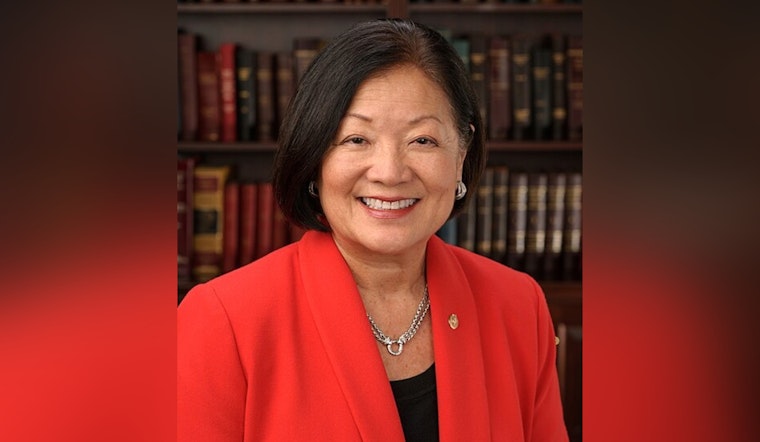
Sen. Mazie Hirono is stepping into a high-stakes fight over who gets heard in Washington, joining a Senate push to lock federal language-access protections into law after recent White House and Justice Department moves scaled back multilingual services. The measure, called the Language Access for All Act, would require agencies to offer translation and interpretation and to follow technical rules for AI-assisted tools so language barriers do not block access to federal benefits and services. Supporters say the aim is straightforward: people should not be shut out of Social Security, Medicare or disaster aid because they do not speak English fluently.
Senators file language-access bill
Senators Andy Kim and Mazie Hirono have introduced the Language Access for All Act to permanently codify federal agencies’ obligations to provide “meaningful access” for people with limited English proficiency, according to Sen. Andy Kim's office. The sponsors are pitching the bill as a way to turn what had been agency guidance and policy into statutory requirements that are harder to roll back.
House companion already filed
A companion bill is already waiting on the House side. Rep. Grace Meng introduced the measure with cosponsors Judy Chu, Dan Goldman and Juan Vargas, and it appears in the congressional record as H.R. 7223. According to GovInfo, the House version was referred to the Committee on Oversight and Government Reform after its January introduction.
Where the push is coming from
The new legislation is framed as a direct response to Executive Order 14224, which designated English as the official language of the United States and instructed the Attorney General to revisit prior limited-English-proficiency guidance. As outlined by The White House, the March 1, 2025 order revoked earlier guidance and directed agencies to implement the change consistent with applicable law, effectively signaling a narrower approach to multilingual services.
DOJ guidance tightened services
That signal turned into concrete policy over the summer. On July 14, 2025, the Department of Justice released interim guidance implementing the executive order and temporarily suspended some public-facing LEP materials while it conducts a broader review. The guidance directs agencies to minimize “non-essential” multilingual services and to redirect certain resources toward English-language education, according to the Justice Department. DOJ also said it will lead a coordinated interagency effort to ensure compliance with the president’s directive.
Bill specifics: AI, complaints and coordinators
The Senate draft goes deep into the mechanics of how language access would work on the ground. Each federal agency would be required to designate a language-access coordinator, develop a public language-access plan and join an interagency working group that shares best practices and reports back to Congress. The bill would also create a public complaint system and require agencies to publish their language-access plans on LEP.gov.
On the technology side, it would set technical standards for agency communications, including automated and AI-assisted language tools, require privacy protections and continuous bias-testing, and bar agencies from fully replacing qualified human interpreters with AI, according to Sen. Andy Kim's office.
Why Hawai‘i stands to gain
Supporters keep coming back to the human scale of the issue. More than 25 million people nationwide, roughly 8% of the U.S. population, report speaking English less than “very well,” a gap that can block access to federal programs and benefits. That national picture is reflected in reporting and recent research on language access challenges, including health care access studies.
For Hawaiʻi, the stakes are especially clear. Sponsors and local advocates note that Asian American, Native Hawaiian and Pacific Islander communities have comparatively high language-access needs, with elevated rates of limited English proficiency in those populations. According to JAMA Network Open, Native Hawaiian and Pacific Islander communities report significant LEP rates and localized need, and federal health data show higher LEP shares in some NHPI subgroups.
Legal stakes and next steps
Legal advocates point out that statutory anti-discrimination protections such as Title VI remain in force even as executive orders and agency guidance shift. State attorneys general are advising that federal directives cannot erase those statutory rights, according to guidance from the New York Attorney General’s office.
The bills are still at the introduction stage, and committee chairs have not yet committed to a timetable. Early coverage of the Senate filing and initial reaction suggests sponsors will push for hearings and committee consideration in the coming months, according to reporting by Federal News Network.
“Language access is a civil right,” Hirono and other backers said in statements reported by local outlets, arguing that putting those protections into statute would make them far harder to undo by executive action alone. Whether Congress decides to take up and fund the standards the legislation outlines will determine how quickly agencies have to update websites, intake systems and vendor contracts to preserve multilingual access.



