

























































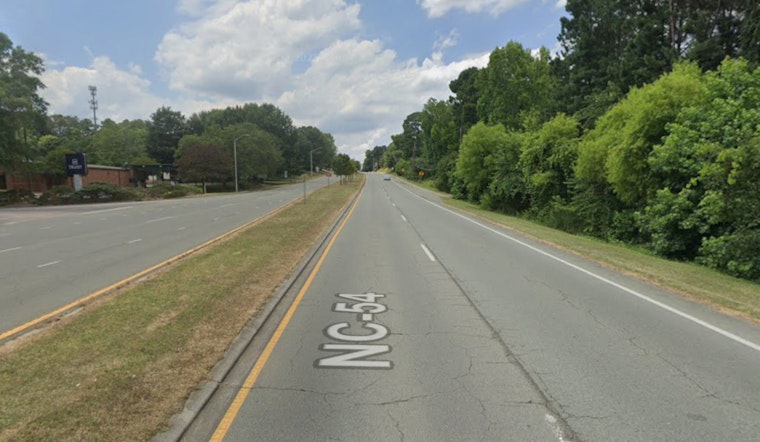
An Orange County judge on Monday, July 13, 2026, dismissed a negligence lawsuit that tried to pin responsibility for the death of 70-year-old Michael Conrad on the Town of Chapel Hill, after he was struck while crossing N.C. 54 in November 2023. With the town now out of the case, the focus stays on the state and the N.C. Department of Transportation to deliver the safety upgrades residents and transit riders have been demanding along the busy corridor.
Accident, suit and ruling
Conrad was hit while crossing the N.C. 54 Bypass near the Kingswood and Laurel Ridge apartment complexes on Nov. 20, 2023, and died two weeks later. His son filed a wrongful-death lawsuit in December 2025, arguing that Chapel Hill had long known the crossing was dangerous. Superior Court Judge Logan Burke tossed the claim on July 13, 2026.
The lawsuit pointed to a 2018 request for a corridor study that led to recommendations in a 2019 safety report, arguing that local officials had documentation in hand and still did not move quickly enough. According to the Raleigh News & Observer, those earlier warnings and recommendations were central to the plaintiff’s theory of negligence.
Why the town says it couldn’t act
Town attorneys countered that state law ties municipalities’ hands when it comes to roads owned and maintained by the state. In their telling, Chapel Hill could not legally install its own signals or crossings on N.C. 54, and any liability for failing to build safety features belongs to the state.
That framework forces towns like Chapel Hill and Carrboro to work through formal agreements and state review processes instead of simply painting a crosswalk or hanging a new traffic signal when they see a problem. The two towns have repeatedly filed joint requests with NCDOT for crossings along NC 54, according to the Town of Carrboro.
Legal implications
The ruling highlights how limited the legal options are for holding municipalities liable for hazards on state-maintained highways. If residents want faster fixes, the decision suggests they may need to pressure state agencies or lawmakers instead of suing local governments.
That narrow pathway for municipal liability was a key theme in the hearing, according to the Raleigh News & Observer.
State crews are already installing crossings
Separately from the lawsuit, NCDOT crews started work in early February to add signalized, pedestrian-activated crossings at Kingswood Apartments, Abbey Lane and Westbrook Drive. Construction has included installing underground electrical conduit and other supporting infrastructure.
The Town of Chapel Hill says work is expected to wrap up later this year, and once the signals are in, town staff plan to upgrade five bus shelters along the corridor. Those three crossing locations were specifically called out in the NC 54 Pedestrian and Bicycle Corridor Safety Study, a 2019 report that details site conditions and recommended countermeasures, available from the Town of Carrboro.
Why state control slows fixes
Local officials and safety advocates say state-level rules for scoring and funding projects tend to favor big highway work, while stand-alone pedestrian improvements can be left waiting in line for years.
Analysis by the Center for American Progress estimates that roughly 94 percent of funding subject to North Carolina’s Strategic Transportation Investments (STI) law goes to highway projects. The Federal Highway Administration outlines how mode-based funding rules and STI implementation help lock in that split.
What the ruling means locally
For residents and bus riders who cross NC 54 every day, the dismissal closes off one legal strategy to force faster municipal action, but it does not stop the physical work that is already underway.
Town and NCDOT officials say the new crossings and bus shelter upgrades are still on track to be completed this year. The signals are intended to cut down on risky mid-block crossings often used by people trying to catch the J route bus. According to the Town of Chapel Hill, the project is expected to improve access to transit stops, and Chapel Hill and Carrboro plan to keep working with NCDOT on future safety phases along the corridor.




