

























































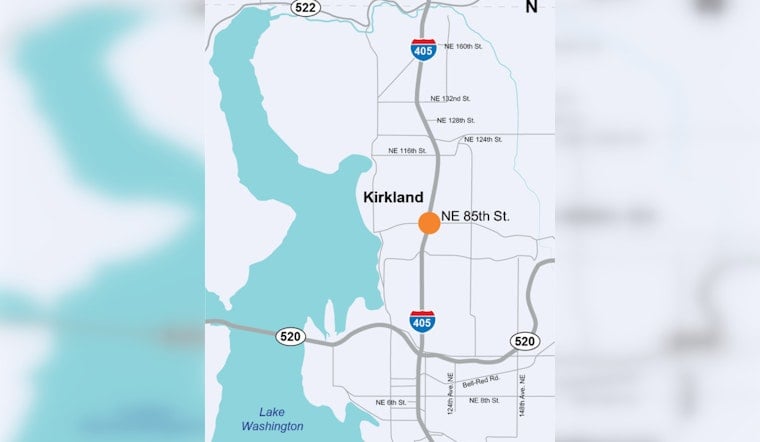
Interstate 405 on the Eastside is getting a full-on makeover, with WSDOT and regional transit agencies stacking interchanges and carving out lanes dedicated to bus rapid transit. At Kirkland’s NE 85th Street interchange, crews are building a three-level hub designed so Stride buses can jump on and off the freeway quickly. Regional operators are aiming to start Stride service along the corridor in the next few years, and recent video coverage has cast the whole effort as a multi-billion-dollar bid to untangle one of the Puget Sound region’s most notoriously clogged corridors.
What WSDOT Is Building At NE 85th
The NE 85th Street project tears out an old two-level cloverleaf and replaces it with a three-level multimodal interchange that folds in an inline Stride BRT station, direct ramps to the I-405 Express Toll Lanes and upgraded walking and biking connections. Major construction kicked off in 2023, and WSDOT says the new interchange is expected to open to traffic in early 2027. This work is one piece of the broader I-405/SR 167 Corridor Program, which the agency says will rebuild interchanges, add lanes and expand transit across the corridor, according to WSDOT.
When Stride Will Start Running
Sound Transit says Stride will operate three high-capacity BRT lines, the S1, S2 and S3, which are set to replace existing express routes and tie Lynnwood, Bellevue, Bothell and Burien together with faster regional service. The agency’s baseline schedule calls for service launches in 2028 for the S1 and S3 lines and 2029 for the S2 line, with buses running roughly every 10 to 15 minutes for much of the day. Sound Transit also says the Stride fleet will be battery-electric and that a new operations and maintenance facility will handle charging and day-to-day service needs, according to Sound Transit.
Bothell Base And The Money Questions
Regional coverage has followed the Bothell groundbreaking for a new all-electric bus base that will anchor Stride operations and charging. The Urbanist documented the ceremony and laid out the corridor work, noting the hefty price tags and construction complexity as agencies juggle multiple major projects at once. Local reporting has also zeroed in on differing cost estimates and the political and neighborhood trade-offs that tend to come with big transit and roadway builds.
Why This Matters For Eastside Commuters
The highway and transit pieces are meant to function as a package: WSDOT’s express toll lane expansions and rebuilt interchanges create room in the median for BRT stations, while Sound Transit’s program-level planning bundles stations, buses and a maintenance base into a single push for frequent service. Sound Transit’s baseline documents list a 2.35 billion dollar program budget for Stride, an approved I-405 BRT project budget around 1.27 billion dollars and a planned Bus Base North facility to support the fleet, a reminder that program totals and on-the-ground contract prices can shift as projects advance, according to Sound Transit. Planners say the end result should be significantly faster, more reliable trips across the Eastside, even if riders and drivers experience the construction headaches and the benefits on different timelines.
For now, Eastside travelers can expect periodic weekend closures and local detours near work zones, along with the gradual arrival of higher-capacity electric buses and the new Bothell operations hub. If the schedule holds, commuters could see Stride stations up and running and quicker trips on I-405 and SR-522 in the 2028-29 window as WSDOT and Sound Transit wrap up the heavy lifting.




