

























































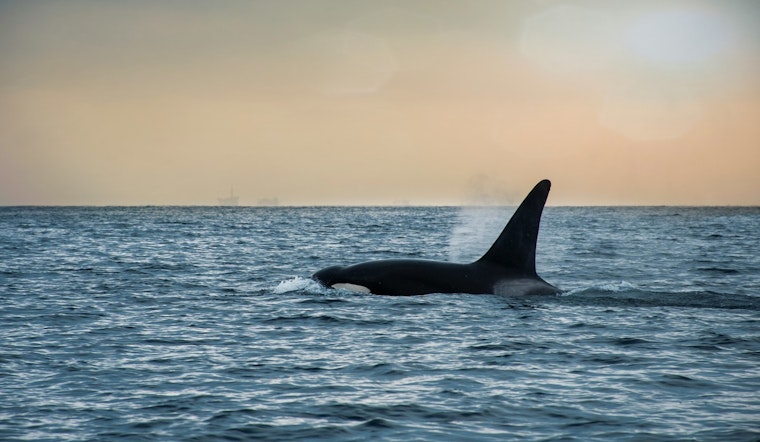
A lone killer whale turned heads roughly 10 miles off the coast of Montauk on Monday, leaving boaters and a conservation group’s shark-camp participants stunned. Witnesses said the black-and-white orca surfaced several times near a school of dolphins before slipping back beneath the waves. The sighting is an unusually close coastal cameo for the East End, where orcas are rarely recorded.
As reported by CBS News New York, the encounter was captured on video and aired as a rare local sighting. The station’s clip shows the animal’s tall dorsal fin knifing through open water while people on nearby vessels point, shout, and film the unexpected visitor.
Campers from the O’Seas Conservation Foundation’s Shark Camp were among the first to spot the whale while on a field trip with Dr. Craig O’Connell, who told News 12 Long Island he suspected the animal might be the solitary male known to whale watchers as “Old Thom.” “There is a lone alpha male orca known as Old Thom, and if I had to guess, this is him,” O’Connell said. Researchers note that photo-identification will be needed before anyone can confirm the whale’s identity.
Could It Be Old Thom?
Old Thom has been documented by researchers and reporters in New England and eastern Canadian waters and is notable for traveling alone and often associating with Atlantic white-sided dolphins. Smithsonian Magazine has profiled the whale, describing his unusual behavior and the challenge of confirming solitary orca identifications without clear markings or sharp photos. Scientists say the Montauk sighting lines up with Old Thom’s reported habits but stress it is not definitive without photographic or genetic confirmation.
Safety and Boating Guidelines
Federal guidance for viewing large marine mammals urges boaters to enjoy the show from a distance. NOAA Fisheries recommends observers remain at least 100 yards from whales and put engines in neutral if animals approach. Those measures reduce the chance of vessel strikes or harassment and help protect both people and animals. Local boating groups and guides say anyone who spots the whale should resist the urge to crowd it and should report unusual behavior to regional marine authorities.
Why the Whale Might Be Here
Researchers note that the New York Bight, the stretch of ocean from Montauk to Cape May, has seen growing numbers of feeding whales in recent years as animals follow prey into nearshore waters. A recent synthesis of sightings and survey data found increasing whale activity in the region and linked many surface-feeding events to abundant forage species such as Atlantic menhaden, according to a study. That prey-driven dynamic makes a transient orca sighting near Montauk plausible, though experts say more data are needed to understand the specifics of any single encounter.
The orca’s appearance is likely to draw extra attention to Montauk’s busy summer waters. Officials and marine scientists urge residents and visitors to give the animal space, photograph responsibly if possible, and let researchers work on confirming the sighting. For now, it stands as a rare reminder of how lively and unpredictable local waters can be this time of year.



