

























































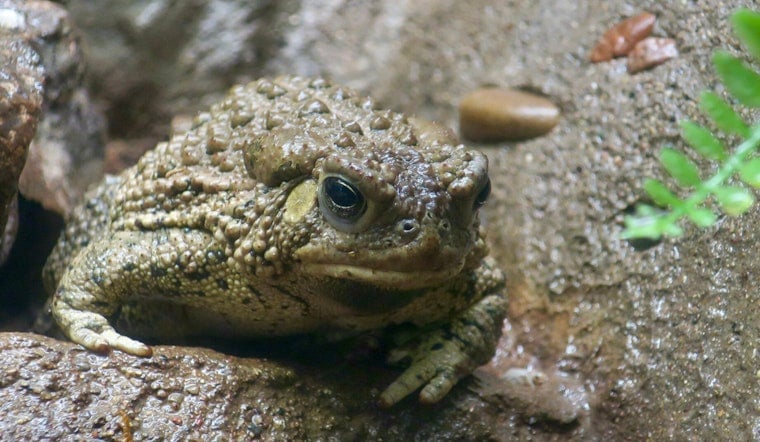
A solitary Woodhouse's toad has turned up at Springs Preserve, the first documented sighting of that species at the site in nearly 65 years. A trail camera picked up an adult male calling in the preserve’s Cienega, and staff say no females were heard answering him. The rediscovery comes decades after the original Las Vegas springs largely dried up around 1962, a loss that wiped out much of the valley’s native wetland life.
Trail camera captured the call
Springs Preserve shared the image and audio in a social post, and the find was reported by FOX5. According to that report, the preserve described the animal as a “possible early colonist” and noted again that no females were recorded answering his call. That makes this the first recorded toad at the site since the original springs went dry in the early 1960s.
Why biologists are watching
Woodhouse’s toad is a habitat generalist that often does well in human-altered wetlands, and biologists say its arrival carries conservation implications because it can hybridize with more range-restricted species. A recent Clark County Desert Conservation Program analysis warns that impoundments and other altered water bodies tend to favor Woodhouse’s toads and increase the risk of hybridization with Arizona toads. The county report also lays out modern monitoring methods, including visual surveys and environmental DNA, that are being used to detect and track both species across the region.
Springs Preserve restoration work
The preserve has spent years rebuilding wetland habitat on the historic spring mound, creating refugium ponds and moving tadpoles as part of broader restoration and rewilding efforts. Those projects, outlined on the preserve’s conservation pages, have restored both permanent and seasonal water at the Cienega and nearby ponds, conditions that can attract amphibians that were once far more common in the valley. The restored habitat is intended to benefit species such as the relict leopard frog along with other native wetland wildlife.
Not yet a recovered population
Experts caution that a single calling male does not prove a breeding population. Biologists look for females, eggs or tadpoles before deciding a species has re-established. The Clark County analysis stresses combining visual surveys with environmental DNA to confirm presence and to screen for hybridization, and federal researchers at the U.S. Geological Survey have documented range shifts and hybridization concerns for Arizona toads in the Southwest. Those monitoring tools will be crucial if staff hope to determine whether the Cienega can support sustained toad reproduction.
What to watch next
The preserve has called the animal a “possible early colonist” and continues habitat restoration and monitoring at the site. For now, the sighting stands as a rare and hopeful reminder that urban wetland projects can lure back surprising wildlife, and that careful, long-term monitoring will be needed to understand which species truly benefit over time.





