

























































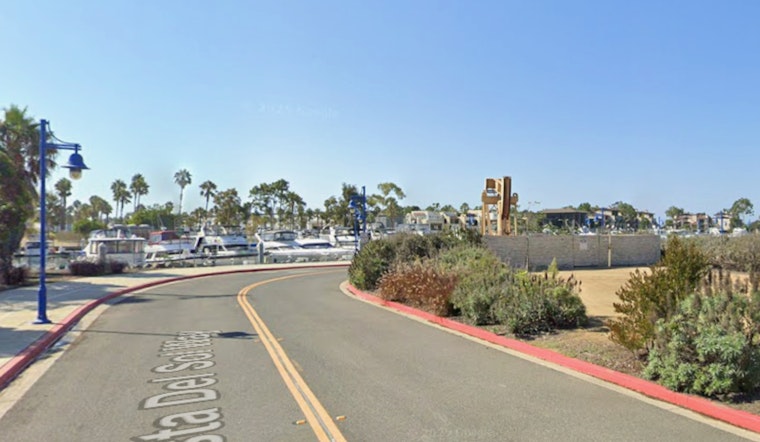
After decades of blocked walkways and confusing signs, a Long Beach homeowners association has agreed to fully reopen a bayfront path that leads to Jack Nichol Park. The California Coastal Commission signed off on a consent settlement last Thursday that requires the Bay Harbour HOA to take down barriers, install clearer signs, and make both the greenbelt and a public road accessible to people with disabilities. The agreement also commits the HOA to pay for park upgrades, including a new restroom and a five-year native planting program.
According to a California Coastal Commission staff report, the settlement resolves long-standing violations tied to a 1976 coastal development permit that required several public bay accessways through the roughly 28-acre Bay Harbour subdivision. The report says the HOA did build the greenbelt, but then gated it off, posted “Bay Harbour” signs that made a public road look private and, in some spots, placed pools and courts inside the required public access easement. Staff recommended a consent cease-and-desist order and an administrative penalty action, along with a package of improvements to restore public use.
Rob Moddelmog, enforcement counsel for the commission, told the Long Beach Post that the settlement avoids a drawn-out legal fight and potentially hefty fines. “Had they not settled with us, we definitely would have pursued more monetary penalties than $2.5 million,” Moddelmog said, according to the Post. Commission staff and advocates said this approach steers money into visible park amenities instead of a state fund.
What's in the settlement
The consent agreement requires the HOA to remove any remaining locked pedestrian gates and unpermitted signs, to bring the greenbelt and the public road up to accessibility standards for people with disabilities and to install new wayfinding signs that clearly point visitors along the greenbelt path to Jack Nichol Park, according to the California Coastal Commission. The HOA must also pay for new park amenities, including a restroom, benches, a water-filling station, bike racks and dog-waste receptacles, and cover restroom maintenance for the first five years. Staff valued the package at roughly $2 to $2.5 million and tied the environmental mitigation piece to a five-year native planting program.
How this fight unfolded
The conflict dates back to the 1970s approval of the Costa del Sol development, when the commission conditioned its coastal permit on recorded public-access easements. The greenbelt was built, but, according to the Long Beach Post and commission documents, access was restricted as early as the 1980s. Commission enforcement kicked in after members of the public and coastal-access advocates reported problems in 2019, leading the agency to issue notices of violation in 2020, the Long Beach Post reported. Gates came down after the commission threatened formal cease-and-desist action in late 2024, but the new settlement locks in public use and adds infrastructure that neighbors have been hearing about for years.
Legal implications
The staff report notes that under the Coastal Act the commission could have sought administrative penalties of up to $11,250 per day for each ongoing violation. Instead, the consent order channels those potential penalties into concrete park amenities and restoration work. Staff said the HOA’s eventual cooperation and the direct public benefits influenced the deal, which also obligates the association to fix any features built inside the recorded easement. That strategy cuts litigation costs and speeds up tangible improvements for people who actually use the park.
What to expect at Jack Nichol Park
Under the agreement, the HOA committed to a five-year native planting program that will add 21 trees and restore habitat buffers, and to fund construction of the long-sought restroom at Jack Nichol Park, according to the Press-Telegram. The settlement also requires new signs directing the public to the greenbelt accessway, upgrades to make paths usable for bikes and wheelchairs and removal of any remaining encroachments inside the public easement. City staff and park regulars said the improvements could make the park far easier to find and comfortable enough to stay longer.
Why it matters
Local advocates say the agreement helps correct a long-running imbalance between a gated neighborhood’s design and California’s public-access rules, and it offers a practical playbook for similar standoffs along the coast. Regional coverage has framed the settlement as an enforcement win that favors on-the-ground public amenities over collecting cash penalties, a model the commission may rely on in future cases, according to reporting by SFGATE. With the commission’s unanimous vote now on the books, the HOA faces a firm schedule to start construction and planting work that should become visible around Jack Nichol Park in the months ahead.




