

























































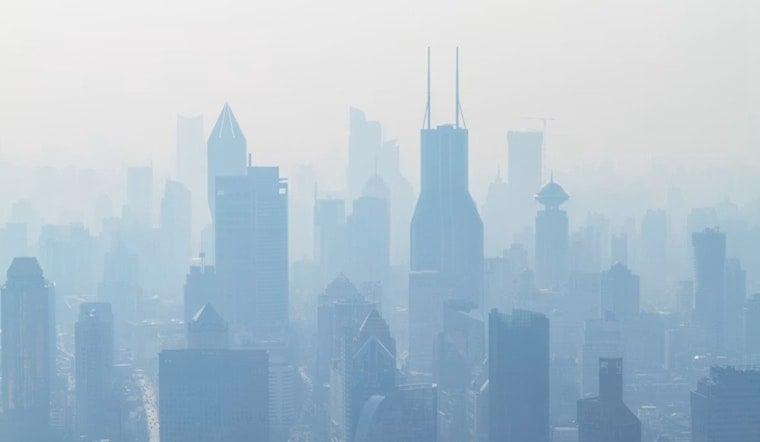
North Texas has now endured 14 days of smog at unhealthy levels this year, a grim summer tally arriving as the region finally gets a less alarming near-term forecast. Air is expected to settle into the “Moderate” range rather than keep pushing into orange or red territory, but that is a downgrade from bad—not a clean bill of health.
Latest regional data reported by Fort Worth Report show North Texas has recorded 14 unhealthy-smog days so far in 2026. May 13 was the only day to reach red-level ozone, while May 9 marked the first orange-level day of the season.
DFW’s Ozone Numbers Remain Above The Federal Target
The North Central Texas Council of Governments says the Dallas-Fort Worth region’s 2026 ozone design value reached 82 parts per billion as of Monday, up from 74 ppb when the season began. Frisco currently has the region’s highest monitor reading, and the DFW area remains out of compliance with federal ozone standards, according to NCTCOG data.
A design value is not a single afternoon reading; it is a statistical measure calculated from three years of monitor data. That means a region can remain in nonattainment even when most individual days do not look especially dramatic, because a handful of high-ozone days can drive the regulatory calculation.
Ground-level ozone forms when nitrogen oxides and volatile organic compounds react in sunlight and heat. Major sources of those pollutants include power plants, industrial facilities, vehicle emissions and oil-and-gas operations, while paints and motorized lawn equipment also contribute, as detailed by Fort Worth Report.
Moderate Air Can Still Be A Problem For Some Residents
The Environmental Protection Agency classifies AQI readings from 51 to 100 as Moderate, a range that can still affect unusually sensitive people. Children, older adults, people with asthma or other lung disease, and those who work or exercise outdoors face greater risk from ozone exposure, which can cause coughing, throat irritation, wheezing and shortness of breath, according to the EPA.
The Texas Commission on Environmental Quality forecast ozone near the upper end of the Moderate range in parts of Dallas-Fort Worth on Thursday, with levels expected to ease toward the middle of Moderate on Friday. The agency said the highest concentrations are likely during the afternoon and early evening, while particulate matter could also reach Moderate levels, per the TCEQ forecast.
Residents can reduce exposure by shifting strenuous outdoor activity away from the afternoon, checking the daily AQI, and limiting unnecessary driving on ozone-heavy days. More than 60% of regional emissions come from cars and trucks, the North Central Texas Council of Governments said in its seasonal air-quality guidance, making transportation one of the clearest local pressure points in the smog fight.




