

























































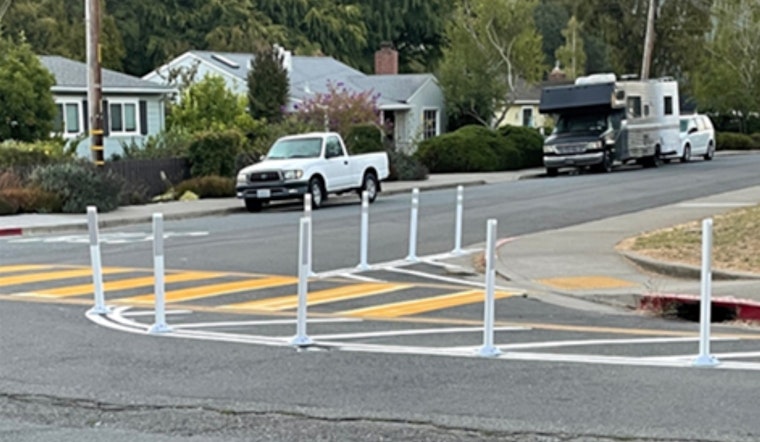
Oakland’s big experiment in community-led traffic safety was supposed to let neighbors reshape their own streets with curb extensions, traffic circles and daylighting to slow drivers and protect people walking and biking. Launched in July 2025 as a three-year pilot, it is now two years in and has only three completed demonstration builds to show for it, leaving residents and safety advocates more than a little impatient. The sluggish pace has pushed community groups to stage DIY demonstrations and, in some cases, put down their own temporary fixes while they wait for city permits.
As reported by The Oaklandside, the Community-Led Traffic Safety (CLTS) pilot had completed just three projects as of July 1. That coverage highlights neighborhood examples, including a painted-tire traffic circle at Miller Avenue and 16th Street that community members installed themselves and paid roughly $1,100 to permit, and shows how these small builds often move faster when residents take the lead.
Oakland Department of Transportation officials set the CLTS pilot to begin in July 2025 and pitched it as a temporary, low-cost path for people to propose and install neighborhood safety treatments. According to the City of Oakland, CLTS permits are issued as Obstruction (OB) permits, the city expects permit review to take 60 to 90 days, and each permit costs roughly $1,200 plus materials. Program guidance says projects are temporary, permits are valid for three months and may be renewed once, so OakDOT can evaluate whether a quick-build should be removed or folded into a standard plan.
Why the rollout is stuck in low gear
City staff had warned early on that even a small number of community-led demonstrations could strain OakDOT’s existing workload, according to a transportation department informational report filed with the City Council. That report, drafted as the pilot was being set up, flagged a basic trade-off between handing more power to neighborhoods and the department’s limited engineering and permitting bandwidth.
That tension has played out on the street. Local reporting describes a handful of DIY or community-funded installations and notes that OakDOT engineers are overwhelmed by demand, a situation that has slowed permit approvals and on-the-ground builds. “We want to reduce the incidents of traffic violence in the city of Oakland,” George Spies told The Oaklandside, a reminder that neighborhoods are pushing hard for faster safety fixes while the bureaucracy catches up.
Community groups step into the gap
Advocates and neighborhood organizations have tried to keep the pilot from stalling completely. The Oakland BPAC blog notes that groups such as Walk Oakland Bike Oakland and Transport Oakland have helped residents prepare CLTS submissions, and Bike East Bay has partnered with local coalitions that are pressing for quicker, school-focused demonstrations and interventions on the city’s High Injury Network. Those groups say clearer templates, streamlined reviews and modest staffing support from the city would help community projects move from concept to curb with fewer delays.
OakDOT says it will continue to learn and adjust as it processes permits and runs the three-year pilot, and the council resolution that created the program directed staff to publish a framework of standard plans after successful demonstrations. Advocates counter that meeting that promise will require more engineering capacity or faster administrative pathways, so neighborhood solutions do not hinge on volunteer labor and out-of-pocket permit fees.




