

























































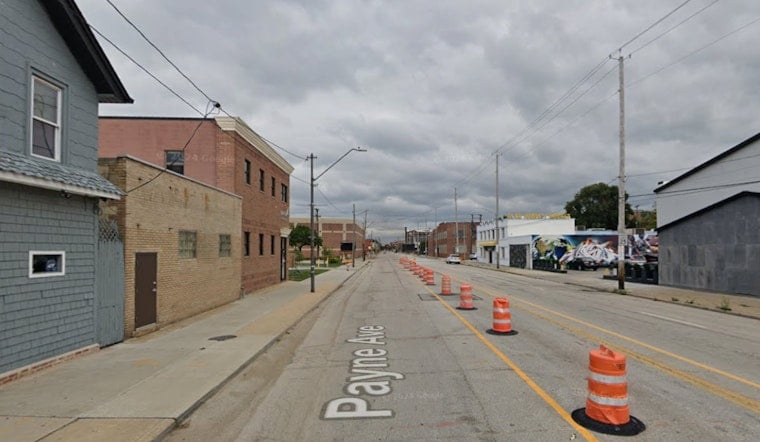
Payne Avenue is getting a full-on street makeover, and this time bikes are finally in the picture. City crews have started striping the corridor as part of a multi-year repaving project that will add separated, parking-protected bike lanes across a long stretch running east to west through Cleveland. Planners and advocates say the work will turn Payne into the first continuous downtown corridor with physically protected bike lanes.
The redesign runs from East 13th Street to East 55th Street, trading wide, fast travel lanes for a calmer layout meant to encourage everyday cycling and safer crossings. For people on bikes and the businesses lining the street, the new setup - with parked cars and delineator posts serving as a buffer - promises a street that looks and feels very different from the Payne Avenue most Clevelanders are used to.
What the protected lanes will look like
The plan calls for parking-protected bike lanes paired with flexible delineators. City officials say high-risk crossings and turning zones will get green paint to make riders more visible where conflicts are most likely.
As reported by Cleveland Scene, crews have already put down markings along several segments as part of the ongoing repaving. Planners say the mix of parked cars, paint and posts is intended to create a clear physical barrier between bike traffic and moving vehicles. Early photos and fresh striping on the ground suggest the city is shifting from concept drawings to a quick-build installation that people will actually be able to ride soon.
Project scope and schedule
The Payne rehab is rolling out in phases, not all at once. Phase 1 covers East 13th to East 30th. Phase 2 runs from East 30th to East 55th. City project flyers indicate construction is expected to continue through late 2026.
City of Cleveland project materials note that Phase 2 was scheduled to begin in mid-2025, while a separate City of Cleveland traffic advisory shows Payne was closed for Phase 1 work in August 2024. Taken together with details shared at public meetings, those documents show that resurfacing and striping are being deployed block by block rather than in a single massive shutdown.
Advocates pushed for this for years
Local bike advocates say none of this happened overnight. The Payne lanes are the product of years of organizing, technical feedback and public pressure.
Bike Cleveland helped pull together early community meetings and specifically pushed for parking-protected designs during pre-construction outreach. Jacob VanSickle, the group’s executive director, told Cleveland Scene that “so many cities have protected lanes - it’s about time Cleveland has some,” a line that has been echoed by residents at public forums.
Where this fits in citywide plans
The Payne project is a key piece of Cleveland’s broader Cleveland Moves initiative, which aims to build a connected system of “high-comfort” and “low-stress” bikeways across the city. Officials have set a goal of adding roughly 50 miles of such lanes by 2028, as reported by Axios Cleveland.
Other headline projects, including the planned Superior Midway running from Public Square east toward East 55th, are intended to knit new bikeways into a real network instead of a scattering of isolated stripes. Local coverage has followed the Midway through its design stages, and WOIO/Cleveland19 has tracked the project’s approvals and design work.
City officials say they plan to preserve on-street parking where they can and to coordinate with nearby businesses while construction is underway. Even so, the driving experience on Payne is set to change. Travel lanes will be narrowed to carve out space for the protected bikeway.
With striping and posts starting to appear, cyclists should begin to see a safer-feeling route take shape in the coming months, even as the city continues outreach and fine-tunes the final design. Riders and the neighborhoods along Payne are now watching to see whether a protected corridor here can boost daily bike trips and calm the cross-streets that feed into it.




