

























































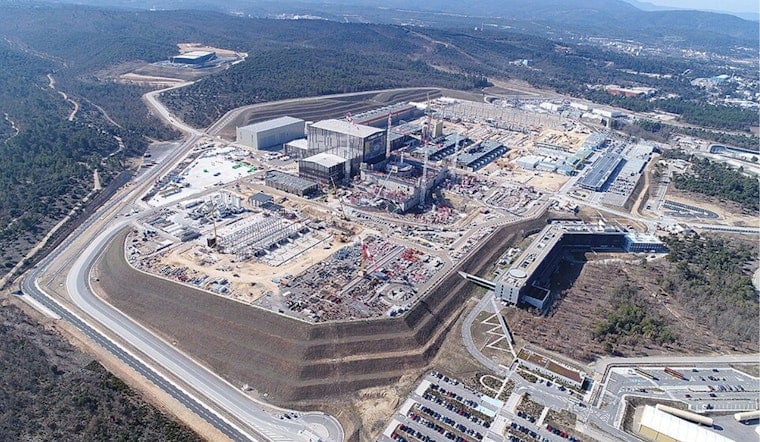
A giant fusion machine under construction in southern France now has a major San Diego-made centerpiece: all six modules of ITER’s central solenoid have been stacked into a towering superconducting magnet. The June 23 milestone marks a visible step for General Atomics, which spent roughly 15 years designing, building and testing the components at its Poway campus.
The modules did not exactly take the local express. According to The San Diego Union-Tribune, General Atomics hauled each module from Poway to the Houston Ship Channel, shipped them across the Atlantic to Marseille and then moved them overland to the ITER site. Stacked together, the six modules form a magnet nearly 60 feet tall and 14 feet wide that weighs more than 1,000 tons.
The Magnet Will Drive ITER’s Superheated Plasma
The central solenoid sits at the heart of ITER’s doughnut-shaped tokamak, where it will help induce and control the electric current inside the fusion plasma. ITER officials say the completed magnet is designed to generate a 15-million-ampere plasma current, reach a maximum magnetic field of 13 tesla and help shape plasma pulses lasting several minutes.
The engineering scale is difficult to overstate. The San Diego Union-Tribune says each module contains about 3.6 miles of conductor segments and more than 180 miles of insulating tape. Lowering the final piece into the stack reportedly took about 30 hours, because a 110-ton component had to be threaded into place with only inches of clearance.
Poway Is Part Of San Diego’s Fusion Footprint
The ITER work adds an international dimension to a fusion research presence that is already well established around San Diego. As Hoodline previously reported, General Atomics operates the DIII-D tokamak in Sorrento Valley, while the U.S. Department of Energy describes DIII-D as the nation’s largest magnetic fusion research facility. Together, the projects give the region a role in both testing fusion physics and manufacturing the hardware needed for larger machines.
This Is Not Yet A Fusion Power Plant
ITER is designed to demonstrate that fusion can produce more energy from the plasma than is needed to heat it, but it will not send electricity to the grid. That makes the project a research platform rather than a commercial reactor, with the central solenoid serving as one of the key systems needed to test magnetic confinement at unprecedented scale, according to General Atomics’ project overview.
The San Diego-made magnet is also part of a broader fusion push that has produced major but very different breakthroughs. At Lawrence Livermore National Laboratory, a 2022 experiment used 192 lasers to compress a tiny fuel capsule and produced more fusion energy than the laser energy delivered to the target, according to the National Ignition Facility.
The Stack Is Finished, But ITER Still Has Miles To Go
With the sixth module in place, ITER’s assembly teams still have to build the support structure around the magnet tower and pre-compress it before the system is installed in the machine. ITER’s construction updates show that the project remains deep in assembly, with additional vacuum-vessel and plant components still moving into position.
For San Diego, the immediate payoff is not a fusion-powered toaster coming out of Poway next week. It is the less flashy but crucial advantage of having local engineers, technicians and manufacturers who can build some of the most demanding hardware in a global effort to turn star-like reactions into a future energy source.



.jpg)