

























































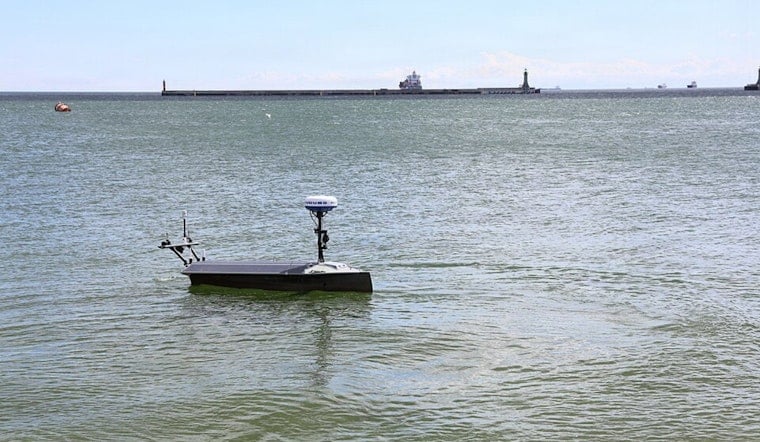
A tiny autonomous boat built in San Diego has captured striking footage of a Chinese warship operating near the Philippines, turning a quiet maritime test into a geopolitical flashpoint. The vessel was unmanned, solar-powered and small enough to launch without a conventional crewed ship nearby. Its video shows how cheaply deployed robots are beginning to fill the ocean’s surveillance blind spots.
The newly public footage was recorded on June 16 in the Bashi Channel, about 65 miles off Luzon, according to the New York Post. Reuters identified the vessel seen in the video as a People’s Liberation Army Navy Type 052D guided-missile destroyer operating inside the Philippines’ exclusive economic zone. China did not acknowledge the ship in comments cited by Reuters.
San Diego Startup’s Tiny Boat Is Built To Linger
Seasats, the San Diego company behind the Lightfish, describes the craft as an uncrewed surface vessel rather than a traditional underwater drone. The company says its roughly 12-foot platform can operate for months, travel thousands of nautical miles and carry cameras, communications gear, navigation systems and interchangeable sensor packages, according to Seasats.
The encounter also builds on a recent company milestone. In a May 27 release published through PR Newswire, Seasats said a Lightfish crossed more than 1,000 nautical miles through the Taiwan Strait over five days while tracking multiple Chinese warships, including a Type 056 corvette.
Seasats Is Scaling Up In San Diego
The dramatic footage arrives as Seasats expands its local operation and its ambitions. The San Diego Union-Tribune reported that the startup had raised $40 million from investors, received more than $100 million in defense contracts and was preparing to move into a larger Clairemont facility.
That expansion is aimed at turning a small-batch workshop into something closer to a production line, with the company seeking to increase output from about one boat a week to roughly one a day. Seasats has also been hiring for software, operations and electronics positions as demand grows for smaller autonomous systems that can monitor large stretches of ocean without putting sailors in harm’s way.
Why The Philippines’ Exclusive Economic Zone Matters
An exclusive economic zone is not the same as a country’s territorial sea, but it does give the coastal state sovereign rights over natural resources and certain economic activity. Under the United Nations Convention on the Law of the Sea rules and Philippine maritime law, Manila asserts those rights in the waters surrounding the archipelago.
That legal distinction makes the video politically sensitive without automatically meaning the destroyer was inside Philippine territorial waters. The Philippines warned all parties to avoid actions that could escalate tensions if a vessel was found trespassing in its maritime zone, the New York Post reported.
For Seasats, the episode is a proof-of-concept for a new kind of maritime watch: low-cost, long-endurance robots that can quietly collect images and coordinates where shore-based radar cannot reach. For San Diego, it is another sign that the region’s defense-tech economy is moving beyond aircraft and ships—and sending small boats into some of the world’s most contested waters.



.jpg)