

























































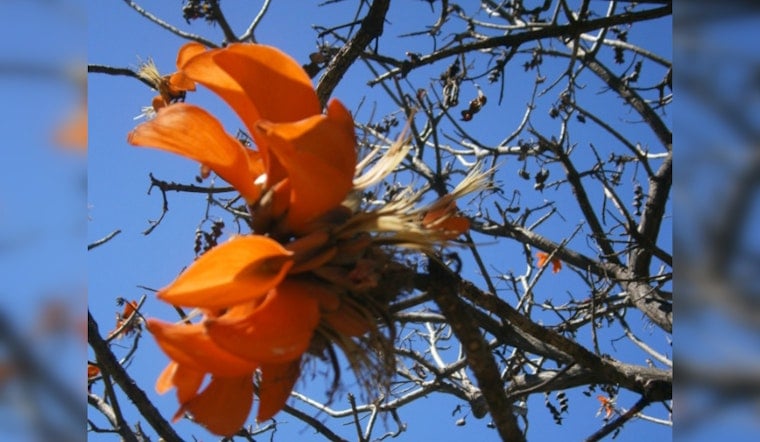
A new arborist risk assessment has delivered bad news for the coral trees in the San Vicente Boulevard median: more than two-thirds are in poor condition and considered likely to fail within two years. The report adds to a steady loss of trees along the corridor, where roughly 32 coral trees have died or been removed over the past four years. Residents and city staff are now bracing for a round of removals and a longer replanting effort.
What the survey says
According to Santa Monica Daily Press, consultant arborist Jonathan Flournoy evaluated 13 South African coral trees between the 100 and 1900 blocks and rated nine as "high" risk, three "moderate" and one "low." His July 1 report, based on inspections on June 23 and June 30, documented extensive root and lower-trunk decay and warned that most of the high-risk trees have a "probable" likelihood of failure within two years.
City forestry and the bigger picture
The city’s Public Landscape Division manages more than 35,000 public trees and more than 250 species under a long-range Urban Forest Master Plan first adopted in 2011 and updated in 2017. The Urban Forest Master Plan frames tree removal, irrigation and replanting as part of a decades-long renewal challenge as many specimens reach the end of their useful life.
Why removal is on the table
Flournoy's written assessment does not mince words: "All 13 coral trees that I evaluated were in poor condition, with very little or no green foliage on the trees." He noted Ganoderma fruiting bodies at the base of one tree and documented cases where 23% to 60% of the trunk circumference was dead. The combination of decay and dieback, he says, leaves few viable options short of removal. The consulting report includes a tree-by-tree risk log and photos.
Pests, drought and a regional trend
Experts point to drought stress and secondary pests such as banana moth and the invasive shot-hole borer/fusarium dieback complex as mounting pressures on urban trees across Southern California. The shot-hole borer was linked to Fusarium dieback in Los Angeles County beginning in 2012, according to a UC ANR/CALFIRE technical note. Nearby Brentwood has reported multiple fallen coral trees this year as well, and Brentwood News says community groups there are responding with emergency trimming and propagation work.
City response and community meetings
The North of Montana Association posted a city statement and the consulting report online, noting that the July 4 failure of one inspected tree accelerated plans to remove the remaining high-risk specimens. According to NOMA, city staff will attend a community meeting on August 6 to discuss immediate safety work, irrigation and long-term replanting options.
What comes next for the median
The arborist recommended that moderate- and low-risk trees be monitored at least every six months but said the high-risk trees have little chance of recovery without removal. As Santa Monica Daily Press reports, the decision to remove any city-owned tree ultimately rests with the city, which is expected to balance public safety with preservation and replanting plans.
How neighbors can follow
Residents who want details can review the consulting report or attend the August 6 meeting. The city invited questions in advance to [email protected] in the statement posted to NOMA. In the short term, neighbors can expect removal crews on the median and a follow-up replacement plan aimed at restoring canopy with species better suited to current drought and pest pressures.




