

























































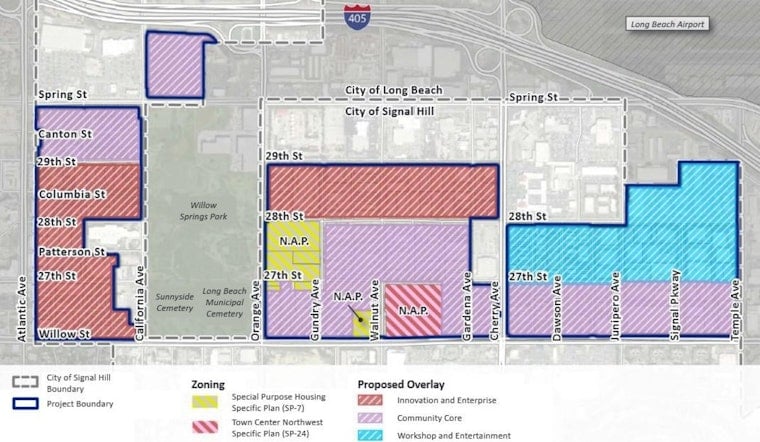
Signal Hill is quietly lining up a massive rewrite of the rules for its northern oil patch, floating a new overlay zoning district that could swap pump jacks for apartments, offices, hotels and fresh commercial space over the next few decades. The roughly 263-acre area between the I-405 and Willow Street would keep its existing oil operations and light industry in place while giving property owners a roadmap to phase in new uses over time. City planners say the overlay would sit on top of current zoning so owners can move gradually instead of flipping the switch all at once.
Where the plan would reach
The proposal would cover about 263 acres from Atlantic Avenue to Temple Avenue, south of the I-405 and north of Willow Street, according to Urbanize LA. That report notes the area was built out for oil drilling between the 1920s and the 1960s and that oil extraction still eats up a big share of the land there. Only about 45 homes and roughly 109 residents are currently inside the study area, leaving a lot of underused industrial parcels and vacant lots on the table.
CEQA process and public review
According to a City of Signal Hill Notice of Preparation, staff plans to prepare a program-level environmental impact report (EIR) to study the overlay’s potential impacts. The notice sets a public comment window and schedules a CEQA scoping meeting for August 12, 2026, and it makes clear that the overlay itself is a regulatory framework, not a green light for any specific project. Even if the EIR checks out, the City Council would still have to vote on adopting the overlay once the CEQA process wraps up.
Three zones, different rules
The draft overlay would split the district into three distinct subzones with different vibes and rules. A Community Core would focus on multifamily housing, retail and live-work space. An Innovation & Enterprise zone would target incubators, aerospace R&D, creative office and medical uses. A Workshop & Entertainment zone would emphasize light industrial, restaurants, breweries and recreation. The Community Core would line the southern edge along Willow, Workshop & Entertainment would tilt toward the northeast, and Innovation & Enterprise would occupy the center and western portions of the district, Urbanize LA reports. The whole setup is meant to sit on top of existing zoning so current uses can stay put while new development is steered with more tailored standards.
How much housing, offices and hotels
City planning documents sketch out a long-range buildout to about 2050 that could add roughly 1,032 net dwelling units and bring in around 2,500 new residents, while boosting employment by about 259 jobs, according to a City of Signal Hill Initial Study. The same study estimates room for about 326,000 square feet of hotel space, roughly 63,000 square feet of additional offices and around 216,000 square feet of retail and commercial uses as the area transitions. Planners stress that these are modeling assumptions for a gradual, market-driven buildout, and that any future project would still have to secure its own entitlements and go through its own environmental review.
Environmental hurdles and who will weigh in
Turning an active oil-field landscape into a mixed-use district will not be as simple as swapping out signs. The planning documents flag hazards and contamination risks, the need for geotechnical work on compacted and disturbed soils, and likely upgrades to sewer, stormwater and utility systems before major housing projects can move forward. State and regional regulators, including CalGEM, the Department of Toxic Substances Control and the South Coast AQMD, are expected to have a say on well work, contamination cleanup and air-quality controls. The city says overlay standards will bake in buffers and compatibility requirements to reduce friction where new homes would sit near industrial or oil-related operations.
Next steps
Public review has already started, with the city circulating its initial CEQA materials and lining up the scoping meeting as part of the environmental review calendar. After the analysis is complete, staff will bring the findings back to the City Council before any decision on adopting the overlay. Even if it is approved, planners are blunt that change will be slow and market-led, with redevelopment expected to roll out parcel by parcel over many years. For now, the proposal puts Signal Hill’s long-running oil fields squarely in the middle of a broader regional debate about how to recycle industrial land sitting close to the port and the freeway.





