

























































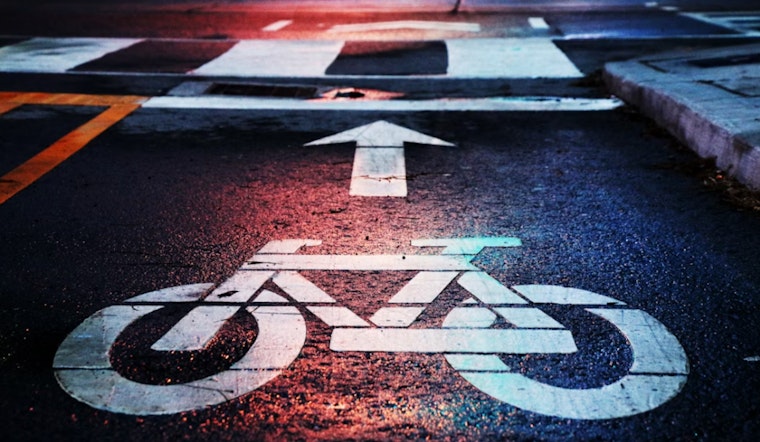
St. Petersburg is giving cyclists on First Avenue North something more substantial than a painted stripe: low, curb-like barriers meant to keep cars from wandering into the bike lane. The city is testing the “Zipper system” on the busy corridor as bicycle and e-bike safety concerns continue to shape the local transportation conversation.
Crews began installing the modular separators between 20th and 28th streets last week, with work expected to wrap by the end of this week if weather cooperates, according to St Pete Catalyst. The devices sit in the narrow buffer between the motor-vehicle lane and bike lane, adding a physical edge where the corridor previously had paint alone.
Why First Avenue North Got The Test Run
The St. Petersburg City Council approved a $48,000 transfer last year for the buffered bike-lane enhancement pilot. The city’s resolution says First Avenue North was chosen because it is a heavily used east-west route with significant bicycle and motor traffic, while the painted buffer added during a 2022 road improvement was too narrow for many conventional separators.
Transportation Manager Cheryl Stacks told Spectrum News that the units are roughly curb height but made from durable plastic rather than concrete. The full pilot is expected to cost about $100,000, including materials and labor, and the city will compare the setup with other options by tracking maintenance, appearance and safety results.
The City Will Measure More Than Crashes
St. Petersburg plans to monitor crashes and traffic speeds, count motorists parking in the bike lane and see whether bicycle use changes. Those measurements could determine whether similar barriers appear on First Avenue South, Dr. Martin Luther King Jr. Street or 31st Street, according to St Pete Catalyst.
The pilot arrives amid a safety problem that has been hard to ignore. The city’s police department reported that e-bike enforcement operations were conducted citywide in 2025 after an increase in serious-injury and fatal crashes, while recent local reporting found that 15 bicyclists were killed by vehicles in St. Petersburg from 2023 through 2025.
Officials are pitching the barriers as another tool, not a magic fix. If the separators make it harder for drivers to drift across the buffer—and less tempting to treat the bike lane as bonus parking—the experiment could offer St. Petersburg a relatively quick way to reinforce bike routes where there is not enough room for a full concrete-protected lane.





