

























































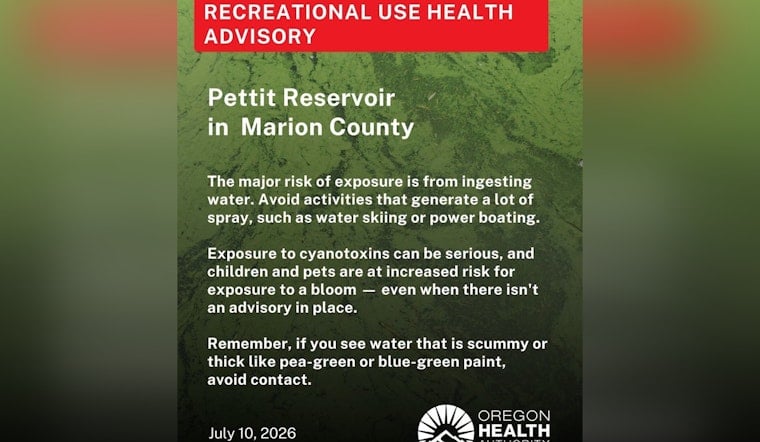
Oregon's summer splash spot at Pettit Reservoir is under a health advisory after state testing found elevated levels of a harmful cyanotoxin in the water.
The Oregon Health Authority (OHA) on Friday issued a recreational use health advisory for the Marion County reservoir after recent water samples showed elevated levels of the cyanotoxin microcystin. The move upgrades a precaution first posted on June 24 and warns visitors to steer clear of activities that kick up spray, because ingestion or inhalation of water is the primary exposure risk.
State Testing Found Elevated Microcystin
OHA's advisory table lists Pettit Reservoir as an "Advisory" site with total microcystin measured at 7.06 µg/L, and notes that a visible bloom prompted the earlier precaution on June 24, according to the Oregon Health Authority. The advisory covers areas of the reservoir where blooms are present and signals that toxin levels are unsafe for swimming and for high-spray boating.
The U.S. Environmental Protection Agency's 2019 recreational guidance places microcystin benchmarks near 8 µg/L for recreational exposure, with much lower advisory levels for drinking water and infants, so Pettit's measured level is close to the federal recreation benchmark, according to the U.S. Environmental Protection Agency. States and health agencies may choose to post advisories at lower thresholds when visible blooms or other local factors indicate elevated risk.
What Visitors and Pet Owners Should Know
OHA says people should avoid swimming and any activities that create spray, such as water skiing or powerboating, in parts of the reservoir where blooms are present, and that "children and pets are at increased risk" for cyanotoxin exposure, according to the Oregon Health Authority. The agency also recommends keeping dogs leashed and away from scummy mats along the shore and cautions that boiling water or using simple campsite filters will not remove cyanotoxins.
Pettit Reservoir is a small Marion County impoundment near Silverton and Stayton and is monitored by federal and state agencies. It appears as an active monitoring site in U.S. Geological Survey records, according to the U.S. Geological Survey. Local land managers and health officials typically watch for blooms through the summer season and update advisory maps as new samples come in.
If you or a pet may have been exposed and develop symptoms such as nausea, vomiting, dizziness, difficulty breathing, or if a dog shows sudden lethargy or seizures, seek medical or veterinary care and contact the Poison Control hotline at 1-800-222-1222. Federal guidance and public-health agencies offer steps for suspected exposures, according to the Centers for Disease Control and Prevention. Reporting suspected illnesses to local health authorities helps public-health officials track and respond to blooms.
OHA's community message was blunt: "When in doubt, stay out," the agency said in its social post. Visitors are urged to check the state's advisory map or the OHA Cyanobacteria Blooms page for updates before heading to Pettit Reservoir.




