

























































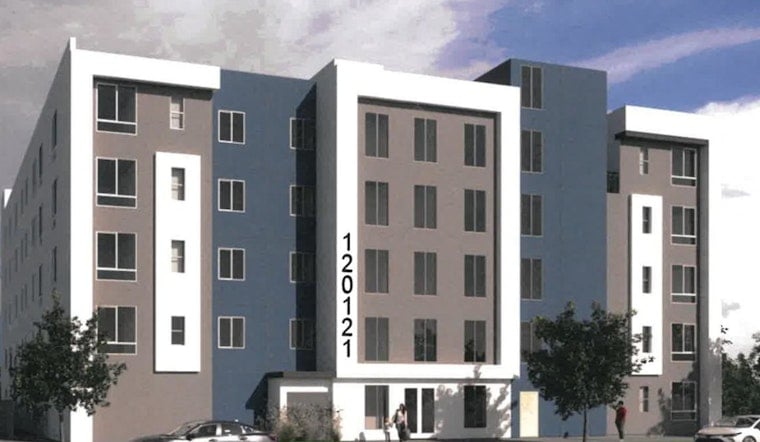
Studio City’s rental scene is in for a major plot twist near the L.A. River. HVN Development has filed plans for a five-story, 78-unit apartment building at 12025 W. Hoffman Street, a site a short walk from Radford Studio Center. The new construction would replace an older low-rise complex and be fully affordable to low- and moderate-income renters, with the developer leaning on density-bonus incentives to reach the proposed height. It is one of several HVN projects across the San Fernando Valley that together could bring hundreds of income-restricted apartments to the area.
Permits, design and what’s planned
Permits on file with the Los Angeles Department of Building and Safety call for a five-story structure at 12025 W. Hoffman Street with 78 apartments and design work by Stockton Architects. As reported by Urbanize Los Angeles, the development is planned as fully income-restricted and relies on density-bonus incentives to exceed the standard zoning limits that would otherwise apply on the site.
Part of a fast-expanding HVN pipeline
The Hoffman Street plan is not a one-off. It joins a growing stack of filings from Irvine-based HVN that are starting to form a mini-portfolio of affordable projects in and around the Valley. The company has recently proposed a roughly 102-unit development on Moorpark Street, a 131-unit project on Acama Street, a 91-unit building in Toluca Lake, and additional income-restricted housing in Westchester and Mar Vista, according to The Real Deal.
The Hoffman site also sits steps from Radford Studio Center, which has been reported to be in talks to sell to Netflix, a potential deal that could reshape both production and property dynamics in Studio City, as noted by the Los Angeles Times. If both the studio sale and HVN’s building spree move forward, this quiet pocket by the river could start feeling a lot busier.
Why developers are leaning on ED1 and density bonuses
HVN is not alone in using every policy lever on the books to make fully affordable projects pencil out. Many of its recent filings, including Hoffman, are structured to qualify under Los Angeles’ Executive Directive 1, which speeds up review for 100 percent affordable developments. The projects also tap state and local density-bonus rules that allow extra floor area and height in exchange for below-market units, according to Los Angeles City Planning.
That policy package has helped accelerate approvals for income-restricted housing in the last few years, incentivizing developers to line up multiple smaller sites and run them through the system at once. HVN’s string of filings fits neatly into that playbook.
Neighbors raise familiar concerns
Even when every unit is reserved for lower-income households, projects like this rarely sail through without at least some side-eye from nearby residents. In Westchester, for example, neighbors have already started tracking one of HVN’s other proposals after the company put forward 77 income-restricted units with no on-site parking, a configuration that has raised questions about spillover onto surrounding streets. That response, detailed in 77-unit no-parking plan, hints at the kind of debates that could surface in Studio City and elsewhere as the developer continues to lean on transit-oriented and parking-light designs.
What happens next
HVN’s other Studio City plans are already visible in the city’s online planning portal, and the Hoffman proposal is expected to follow the same path. Each case moves through Los Angeles’ PDIS review system before any building permits are issued, with applications such as the Moorpark Street project logged in City Planning’s files. Developers still need to secure financing, tax-credit or bond allocations, and construction permits, and members of the public will be able to track progress through posted notices and staff reports as each application advances, per Los Angeles City Planning.
If HVN ultimately builds the small cluster of projects that have surfaced so far, including Hoffman, Moorpark, Acama, Whipple, Westchester and Mar Vista, those addresses together would add roughly 560 income-restricted apartments across the Valley. That would be a significant bump for neighborhoods that have seen relatively little new affordable construction in recent decades, according to reporting compiled by The Real Deal. For Studio City, the Hoffman plan is one more sign that the affordable housing map is quietly, but steadily, being redrawn.



