

























































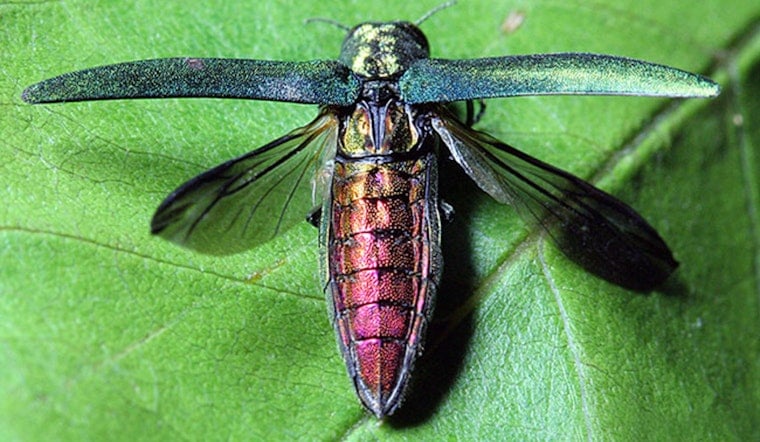
The emerald ash borer, a tiny metallic-green beetle with an outsized reputation for destruction, is closing in on Austin, and city officials want homeowners paying close attention to their ash trees before the bug does. While there are still no confirmed emerald ash borer (EAB) sightings inside Austin city limits, recent detections in nearby counties have local authorities acting as if its arrival is only a matter of time.
“We're sounding the alarm now so that Austinites are aware and have time to prepare,” Zach Baumer, director of Austin Climate Action and Resilience, said, according to the City of Austin. The city estimates there are more than 1 million ash trees across Austin, nearly 3% of the municipal tree population, and an inventory found roughly 2,000 ash trees along rights-of-way, in parks and at schools. Officials are telling residents that some trees can be treated, but that removal may be the safest option once an ash is severely infested or has become hazardous.
Where EAB Has Turned Up Near Austin
The emerald ash borer was first detected in the United States in Michigan in 2002 and reached Texas in 2016, according to the Texas A&M Forest Service. As of June 2026, Texas A&M lists 36 Texas counties with confirmed EAB, including Bell and McLennan counties to the north of Austin, which helps explain the city’s heightened advisory. Adult beetles generally do not travel very far on their own, but the pest can make big jumps when infested firewood or ash material is hauled from one community to another.
What To Look For
Experts say the most dependable red flags are up top and under the bark. Homeowners are urged to watch for thinning or dieback at the top of the canopy, epicormic shoots (suckers) sprouting from the trunk, and vertical bark splits that reveal S-shaped larval galleries underneath. Another key sign is the presence of small, D-shaped exit holes about one-eighth of an inch wide. Adult emerald ash borers are metallic green and typically emerge in spring, and university extension guides note that emergence can begin in April and continue into early summer, with timing influenced by local conditions. If you suspect an infestation, photograph the tree, any exit holes or beetles, and hang on to the images for reporting and evaluation.
Treatment, Removal And Rules
Some high-value ash trees can be protected with systemic insecticides such as trunk injections or soil drenches using products like emamectin benzoate, although those treatments can be costly and usually need to be repeated every few years, the Texas A&M Forest Service notes. Where trees are already heavily infested or pose a safety risk, officials say removal combined with on-site chipping or burning is often the safer route, since EAB can survive for a while in cut wood. The Texas Department of Agriculture also maintains quarantines and movement rules on ash wood, nursery stock and firewood from affected counties to slow long-distance spread, and residents are urged to check the department’s guidance before moving wood across county lines.
Austin officials say they will continue trap monitoring and coordination with state and federal partners, and they have posted identification guides and other resources on the city’s emerald ash borer page for residents and arborists. KEYE/CBS Austin first published the city’s advisory and includes the city’s contact information and next steps for reporting, and the Texas A&M page lists the EAB hotline (1-866-322-4512) for reporting suspected sightings to state and federal partners. Photograph any suspect beetle or tree and report it so specialists can confirm whether the emerald ash borer has finally arrived in the city.





