

























































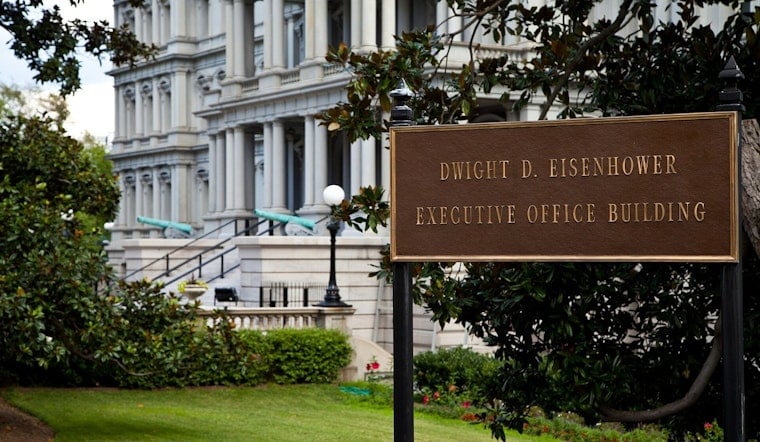
The Trump administration wants to paint four small test patches onto the Eisenhower Executive Office Building this week, turning a proposed cosmetic tweak into a high-stakes fight over who gets to alter Washington’s historic landmarks. Preservationists say even the test itself could damage the gray-granite building before a judge decides whether the broader white-paint plan can proceed.
The proposed work could begin as soon as Thursday at the 1888 building next to the White House. Preservationists are seeking an emergency injunction, and the plan calls for four 2-by-2-foot panels in inconspicuous facade locations, plus up to 10 samples from deteriorated stone for lab analysis, according to ABC17 News.
The emergency request is aimed not only at the paint but at the process behind it. The Washington Post reported that a July 20 court filing said the White House Office of Administration would lead testing and evaluation instead of the General Services Administration, a shift critics say could sidestep the review rules normally attached to federal historic properties.
Administration officials say the testing is not a final decision to paint the entire building and that required environmental and preservation analyses are still underway. The government also says it remains engaged with the Commission of Fine Arts and National Capital Planning Commission, which have asked for more information, ABC17 News reported.
The Fight Is About More Than A Color Change
The EEOB was built in stages from 1871 to 1888 in the French Second Empire style, with massive granite walls, slate mansard roofs and cast-iron details. Official minutes from the Commission of Fine Arts describe it as a National Historic Landmark and say the administration wants white silicate paint to align the building visually with the White House. The commission approved the concept only subject to testing and additional comments.
That proposal has met a wall of expert opposition. A March consensus assembled by Cultural Heritage Partners said mineral-silicate paints are not suited to granite, while the National Trust for Historic Preservation warned the coating could trap moisture, damage the stone and create a cycle of cleaning and repainting at taxpayer expense.
What Happens Before Thursday’s Test
The National Capital Planning Commission treated the proposal in May as a concept review, not a final green light, and called for more information on the paint’s adhesion, water infiltration, maintenance, removal and performance on granite. That leaves the federal court fight on a tight clock: preservationists want the judge to pause the test, while the administration says testing will help determine what the stone can withstand.
The building houses about 1,500 federal employees, according to Cultural Heritage Partners. But the legal theory at stake is much bigger than four painted squares: whether the executive branch can start altering a protected landmark first and let the preservation process catch up later.





