

























































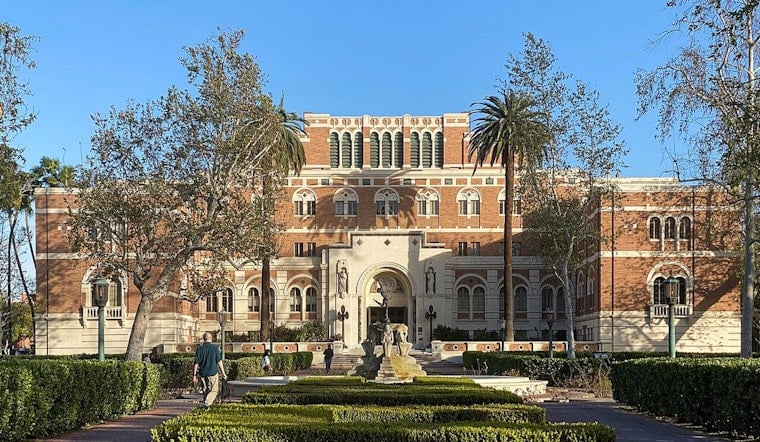
USC has been tapped to play a lead role in a new federal push to supercharge scientific discovery with artificial intelligence, and it is a big bragging-rights moment for the Los Angeles campus. The university will head a multi-institutional team under the Department of Energy’s Genesis Mission that aims to teach AI to predict turbulent flows - a notoriously tough problem in engineering that affects aircraft, energy infrastructure and manufacturing. The selection landed Wednesday as the Department of Energy began rolling out the first wave of projects under its Genesis RFA.
USC Team Aims To Teach AI To 'See' Turbulence
USC will lead a team developing a new kind of AI that can recognize and forecast the small-scale flow structures that drive turbulence. “Predicting how turbulence evolves means following millions of tiny motions in the air as they interact - more than even today’s fastest supercomputers can calculate,” project principal investigator Iván Bermejo-Moreno said, as reported by USC Today.
DOE Awards List Puts USC On The Board
The Department of Energy’s awards list for the Genesis RFA includes an entry for Iván Bermejo-Moreno at the University of Southern California, titled “AI-driven subgrid-scale model for large-eddy simulation of turbulent flows based on geometry and tracking of turbulence structures,” confirming USC's selection. The item appears in a long roster of Phase I selections in DOE's initial Genesis portfolio; see the Department of Energy awards list.
How This Could Reshape Engineering Workflows
Researchers say that if AI can be trained to spot and track coherent flow structures, simulations could become dramatically faster and more precise, turning month- or year-long calculations into something far more manageable. Those gains could translate into lighter, more fuel-efficient aircraft, more resilient power-grid components and quicker development cycles for new energy and manufacturing technologies, USC officials say; read more in USC Today.
Partners And A Training Pipeline
USC said the project will bring in partners such as the University of Michigan and Argonne National Laboratory, deepening campus ties with national labs and industry collaborators. The University of Michigan has been coordinating campus activity around the Genesis Mission, and USC students regularly participate in Argonne’s Training Program on Extreme-Scale Computing (ATPESC), which prepares researchers to run workloads on leadership-class supercomputers. See local reporting in MyNewsLA, the University of Michigan’s Genesis Mission notes at the University of Michigan, and Argonne’s ATPESC program at Argonne National Laboratory.
What Comes Next
The teams named in the first wave now move into award-negotiation talks with DOE, and the department is blunt that selection alone does not guarantee final funding. If negotiations succeed, awardees will gain access to the Genesis Mission platform - agent frameworks, advanced models and high-performance computing resources - to build and test AI-enabled scientific workflows, the U.S. Department of Energy said in its announcement.
For USC, the Genesis nod is both a high-profile research opportunity and a signal that the university’s investments in human-centered AI and cross-sector partnerships are starting to pay off. Researchers say the turbulence project is a proving ground: if AI can accelerate one of science’s toughest computations, the same techniques could spread to materials, fusion and climate modeling.





