

























































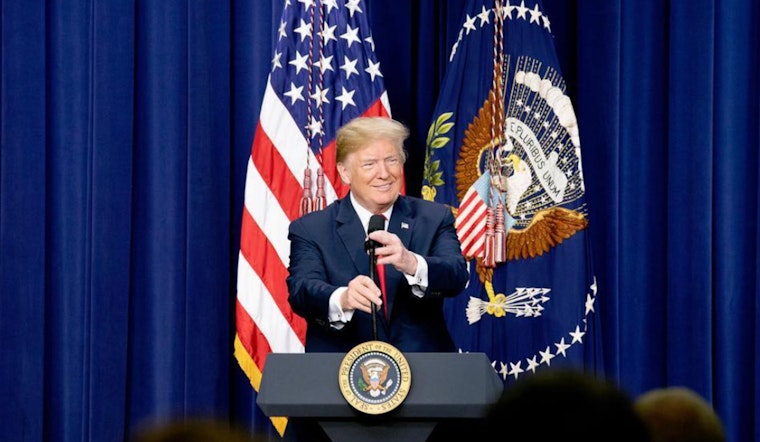
A White House teleprompter operator is under federal scrutiny after regulators say he quietly turned insider knowledge of President Trump’s scripted remarks into a six-figure payday on a prediction market. Investigators say the wagers targeted so-called “mentions” contracts on a regulated exchange and generated more than $100,000 in profit. The staffer remains on duty while both the platform and federal regulators dig into the trades.
What investigators found
According to ABC News, the operator, identified as Gabriel Perez, placed wagers on Kalshi that were tied to more than a dozen of the president’s speeches over roughly three months and is in talks with the Commodity Futures Trading Commission to resolve allegations that he used information from his job to net over $100,000. The reporting says the bets included the State of the Union in February, a December primetime address, a January speech at Davos and March remarks at a Medal of Honor event, and that investigators flagged instances where he pulled out of positions mid-speech when Mr. Trump skipped lines that had been expected.
How Kalshi says it caught the activity
Kalshi’s surveillance team spotted trading patterns on its “Mentions” market that looked out of the ordinary and alerted regulators. The exchange’s lead lawyer said the firm “promptly flagged and referred these trades to the CFTC” and has been cooperating with investigators, according to ABC News. The White House told reporters the staffer is cooperating with regulators, and sources said the CFTC briefly summarized the matter for federal prosecutors in Manhattan, who declined to open a criminal case.
Regulatory backdrop
The Commodity Futures Trading Commission has reminded exchanges that event contracts fall under the Commodity Exchange Act and issued guidance instructing designated contract markets to maintain robust surveillance and to refer suspicious trades, as laid out in a CFTC advisory earlier this year. That advisory gives the agency authority to pursue civil enforcement, including disgorgement of profits, monetary penalties and trading suspensions, when platform rules or federal law are violated.
Criminal cases show the stakes
Federal prosecutors have already brought criminal cases tied to prediction-market bets, including an April indictment of a U.S. soldier accused of using classified information to profit on Polymarket and a May complaint charging a Google software engineer who allegedly used internal search data to win about $1.2 million. Those actions, detailed by the Department of Justice and the U.S. Attorney's Office for the Southern District of New York, underscore that criminal charges are possible when authorities believe nonpublic information was misused.
Legal implications
If regulators conclude the teleprompter operator used information from his job to place wagers, the CFTC can push for a civil settlement that would require returning the profits and could bar future trades. Any criminal case would hinge on misappropriation or commodities-fraud statutes and would typically require proof of an intent to deceive or conceal. For now, sources say the matter appears headed toward a CFTC settlement rather than a criminal indictment, a path that could resolve the case without a trial but still carry significant financial and professional fallout.
What to watch next
Kalshi has tightened its platform rules recently, including requiring users to disclose their employer, and exchanges are likely to face renewed pressure to keep a closer eye on politically sensitive markets. Perez remains on the job and is cooperating with investigators, and any settlement or enforcement action will be watched closely for clues about how exchanges and regulators plan to police event contracts that track the words and actions of public officials.





