

























































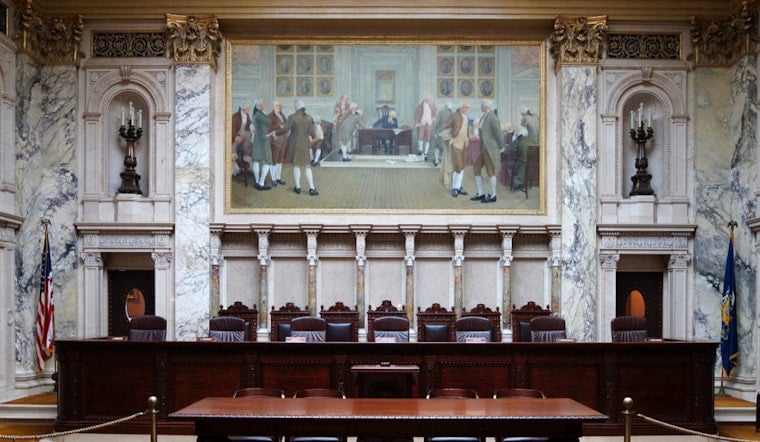
The Wisconsin Supreme Court on Tuesday slammed the brakes on a conservative group's push to get its hands on records about voters found legally incompetent, ruling that the forms used to notify election officials are part of confidential guardianship files and must stay sealed. In a 5-2 decision, the court held that completed "Notice of Voting Eligibility" (NVE/GN‑3180) forms are created within guardianship proceedings and are shielded by state law, sending the long-running public-records fight back to lower courts while keeping the names and sensitive details of people under guardianship out of public view.
What the court decided
The majority concluded that NVE forms are "pertinent to the finding of incompetency" and therefore fall within the statute that keeps guardianship records closed, according to the opinion posted by the Wisconsin Court System. Justice Janet Protasiewicz wrote the opinion for the court, joined by the other three liberal justices and Justice Brian Hagedorn. The ruling reverses a court of appeals decision that had ordered the records released with redactions and sends the case back to the lower courts to proceed under existing precedent.
Who brought the challenge
The petitioners, the Wisconsin Voter Alliance led by Ron Heuer and represented by attorney Erick Kaardal, sought completed GN‑3180 forms from multiple counties in order to cross‑check names against voter rolls. As Urban Milwaukee reported, the requests were part of the group's broader post‑2020 effort to obtain records it says could reveal ineligible voters. Kaardal argued in court that the forms could be redacted to protect privacy while still allowing verification, while county officials responded that any meaningful cross‑checking would require releasing names and addresses.
Dissent and the transparency argument
Chief Justice Annette Ziegler, joined by Justice Rebecca Bradley, dissented, arguing that NVEs are generated only after a court has already made an incompetency determination and therefore do not, by their nature, bear on the finding itself. On that view, the forms should be open to the public under Wisconsin's open‑records law, according to AP. The dissent warned that the majority's reading of the law creates an overbroad shield that could limit public oversight of how voting‑eligibility decisions are implemented. The split highlights a core tension between transparency claims and efforts to protect the privacy and dignity of people under guardianship.
Privacy advocates respond
Disability‑rights and privacy advocates welcomed the decision as a safeguard for vulnerable Wisconsinites who could be singled out or targeted if their guardianship status and personal information became public, according to Wisconsin Examiner. "Like all Wisconsinites, individuals under guardianship deserve dignity and respect," Law Forward legal fellow Taylor Gilbertson said in a statement quoted by the Examiner. Supporters of broad open‑records access counter that public scrutiny is vital to election integrity, but the majority opinion keeps the door open only for narrower, court‑ordered access in specific cases.
How this fits into post‑2020 fights over voter data
The petitions are one piece of a larger wave of efforts after the 2020 election by some groups to obtain detailed voter‑related records. Many of those attempts have been turned back in court, according to reporting by The Washington Post. Heuer and the Wisconsin Voter Alliance began filing requests and lawsuits in multiple counties in 2022, and Heuer previously served as an investigator in the post‑2020 review led by former Justice Michael Gableman, as news coverage has noted. Election officials and watchdogs have warned that wide‑open access to guardianship records could expose people to scams and other harms without clear evidence of widespread ineligible voting, concerns detailed by Wisconsin Watch.
Legal takeaway for clerks and courts
State law provides that "all court records pertinent to the finding of incompetency are closed," a rule set out in Wis. Stat. § 54.75 that the justices relied on in reaching their decision, according to Justia. In practical terms, registers in probate and county clerks are expected to treat completed GN‑3180/NVE forms as nonpublic unless a judge orders otherwise, although parties can still seek narrowly tailored access through established court procedures.
The ruling limits the ability of private groups to mine guardianship dockets for names and addresses, while preserving limited legal routes for authorized access. For now, NVE forms will stay off standard public‑records request lists as lower courts apply the Supreme Court's guidance to the pending cases.





